
Espalier Fruit Tree Design Library
There is no limit to the number of espalier designs (forms, patterns, shapes) that temperate fruit trees can be successfully trained to. Here are a few. I will add more in the near future.
Click on the images below to enlarge and scroll through them
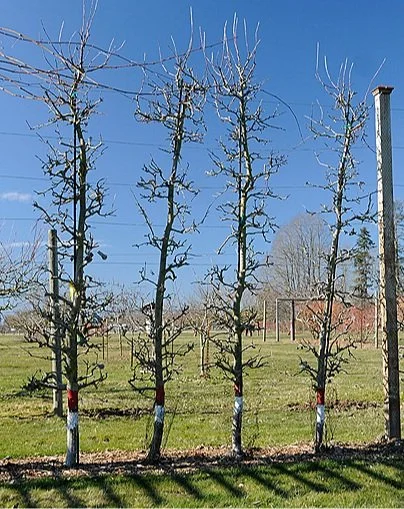
These are Single Vertical Cordon apple trees growing at the Washington State University Research facility located in Mount Vernon, Washington State. This espalier collection is managed by Northwest Fruit (https://nwfruit.org/)
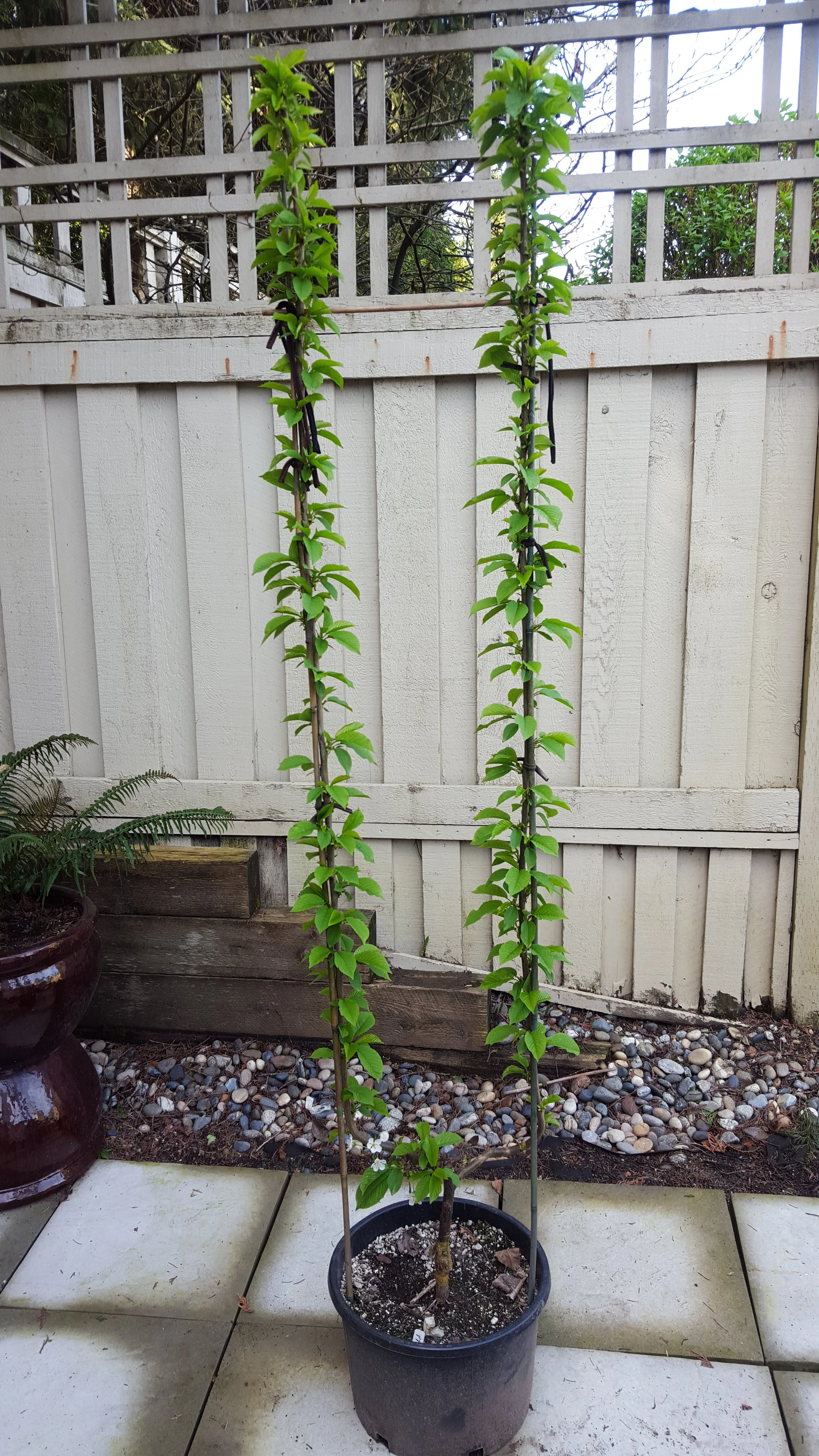
Verrier Palmette Single U (Vertical Double Cordon) Plum Plum This is an Italian Prune Plum. Plums, Sweet Cherries, Apricots and similar can all be trained to any of the designs usually used for apples and pears. I trained this tree in my backyard.
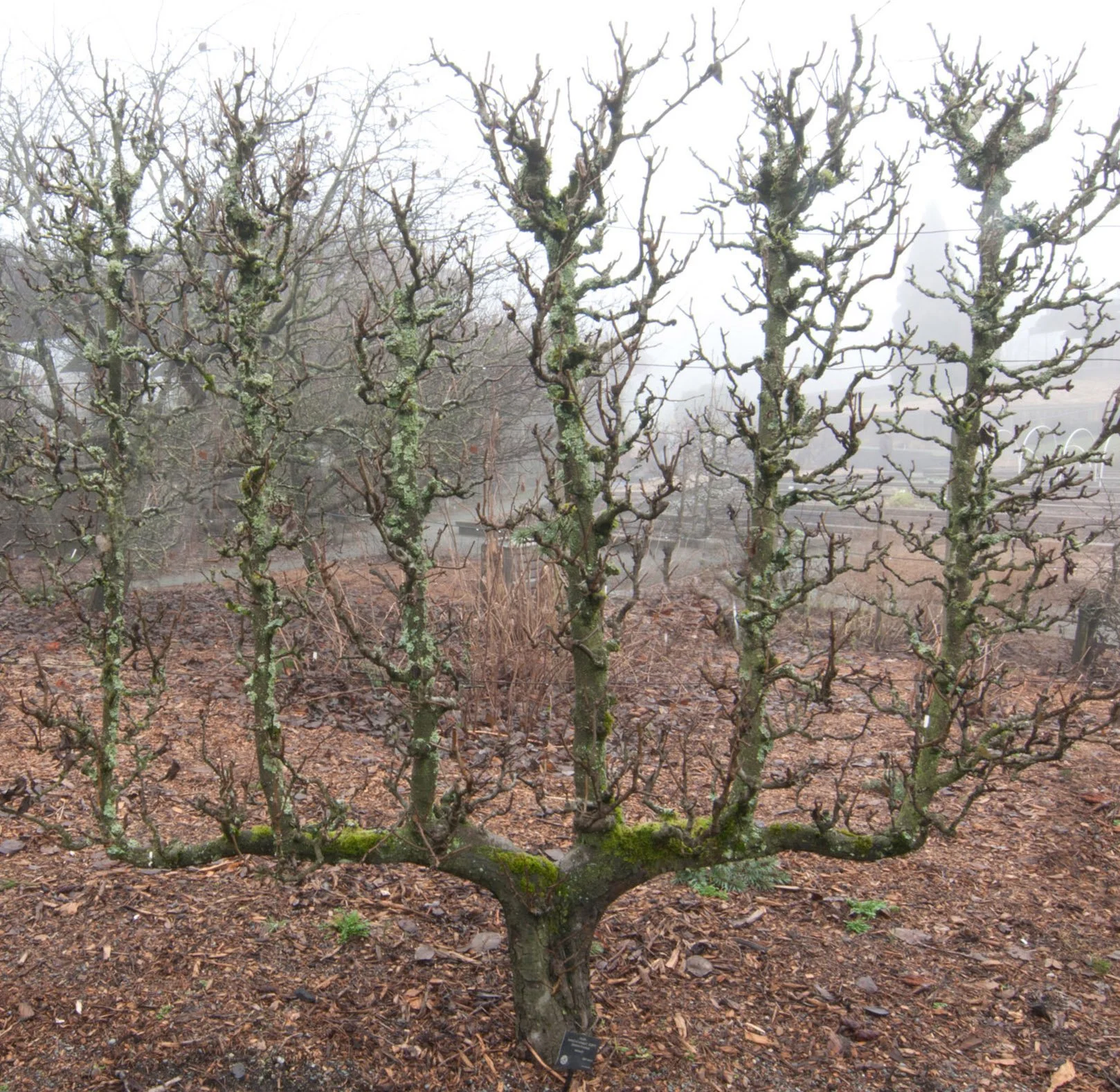
This Multiple Vertical Cordon Pear was in the original University of British Columbia Botanical garden espalier collection. This tree is an apple about 20 years of age. Multiple Vertical Cordons design is virtually identical to the Planar Fruiting Wall that is now being adopted by commercial orchardists world wide.
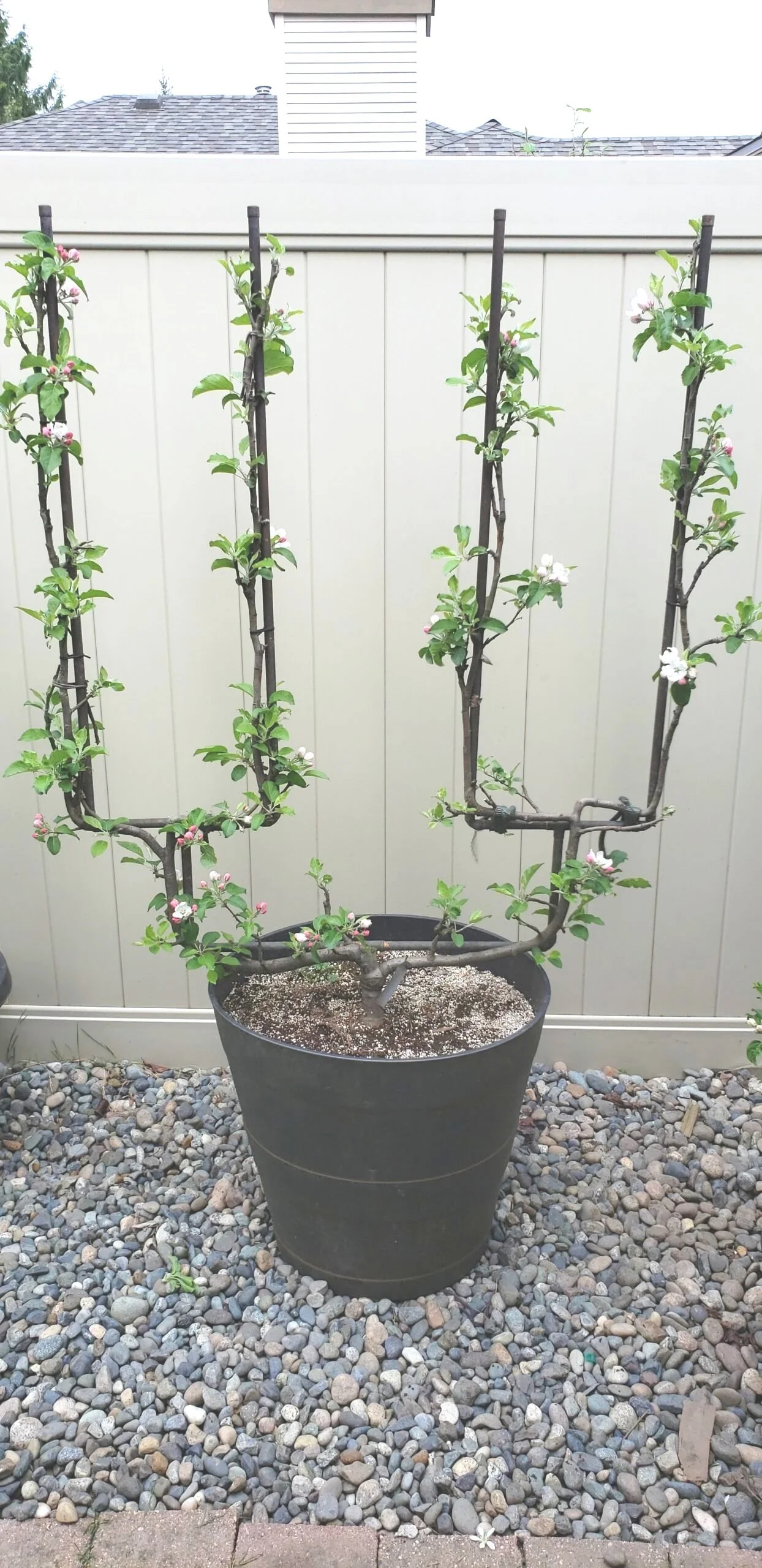
Verrier Palmette Double U Candelabra Florina apple tree that I trained onto a copper pipe trellis in this large container. This tree is 3 years old in this picture, it is now 10 years old and still producing annual crops of great fruit. This variety is resistant to apple scab.
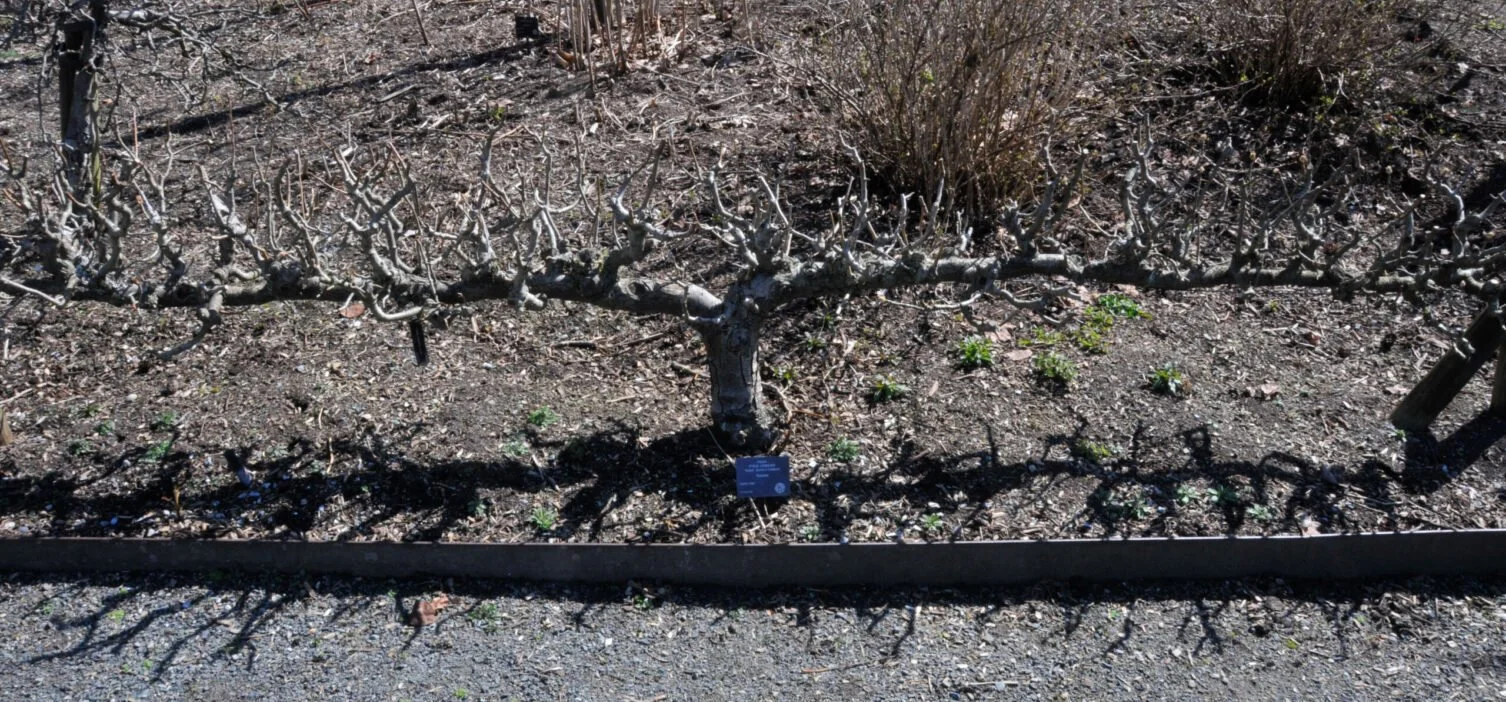
Horizontal two-sided Cordon (double stepover) This apple about 15 years old on M9 rootstock was in the original University of British Columbia Botanical garden espalier collection.
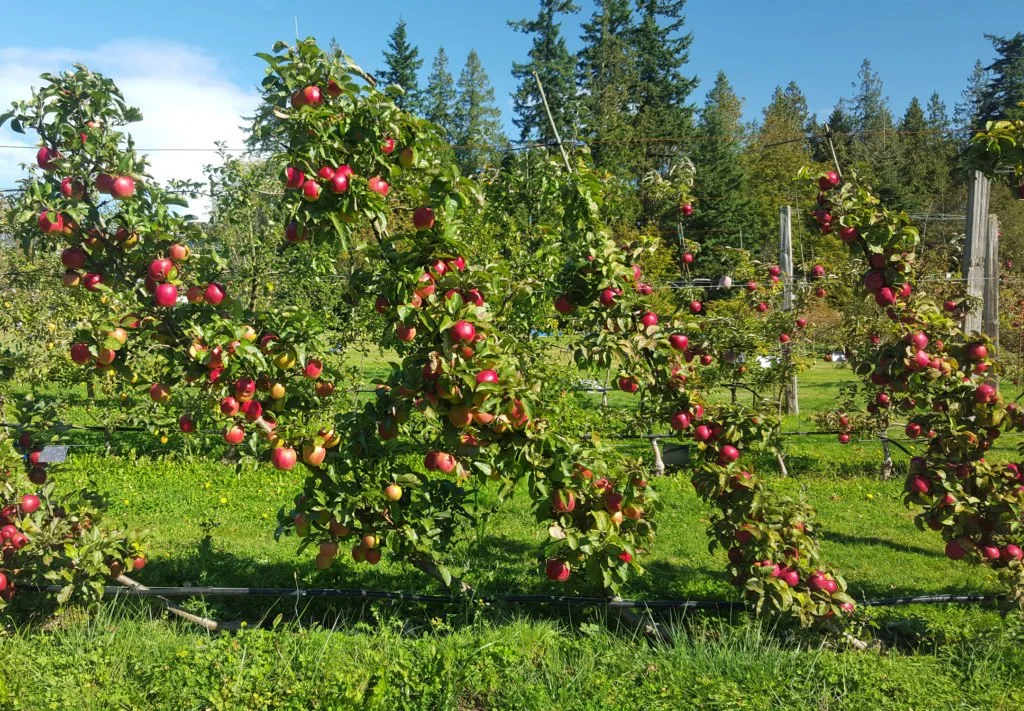
Single Oblique Cordon Oblique trees can be grown at any angle. This is one of the easiest espalier designs to train and maintain.
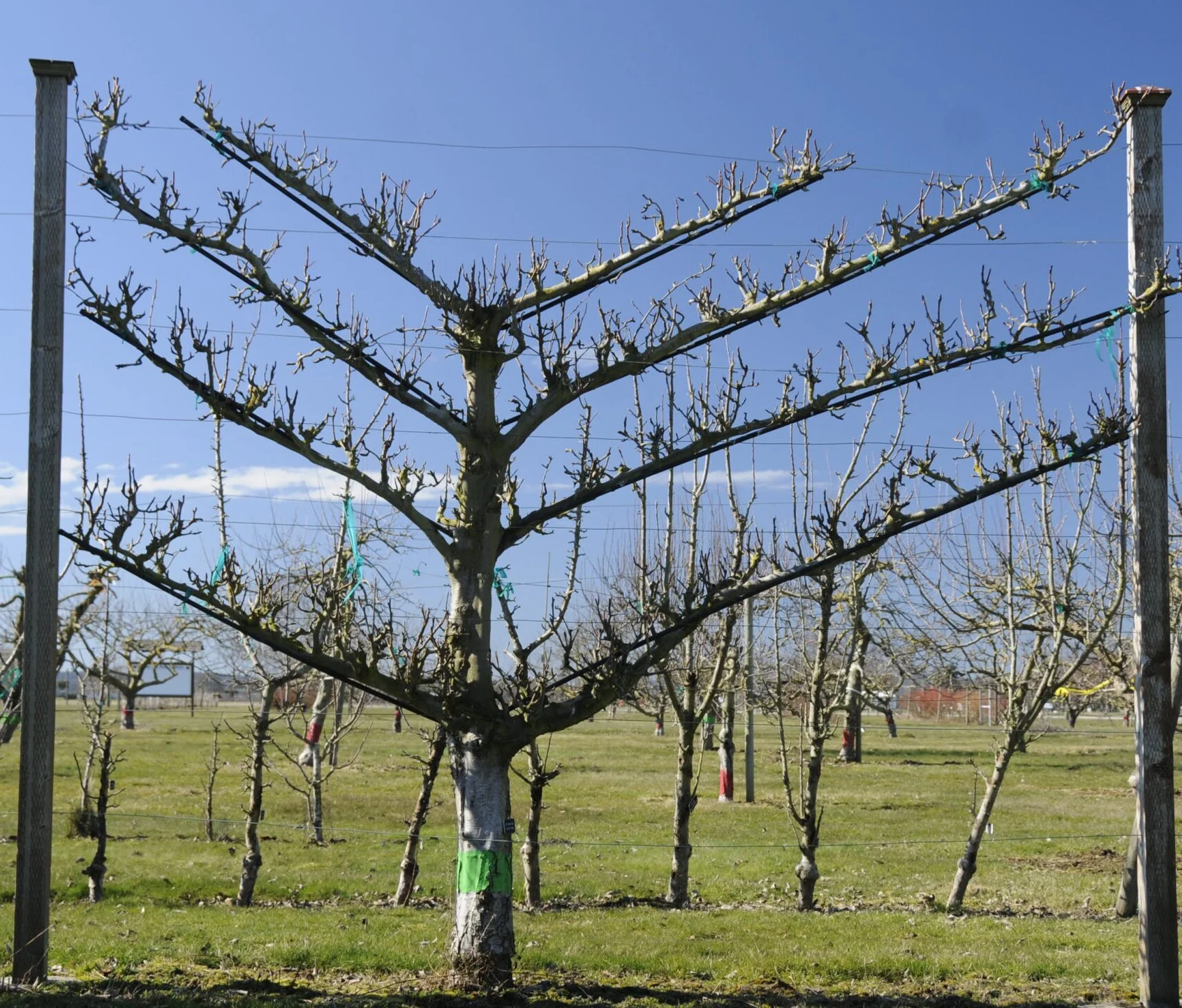
This is an Palmette Oblique Cordon (Multiple Oblique Cordon) pear tree growing at the Washington State University Research facility located in Mount Vernon, Washington State. This espalier collection is managed by Northwest Fruit (https://nwfruit.org/)
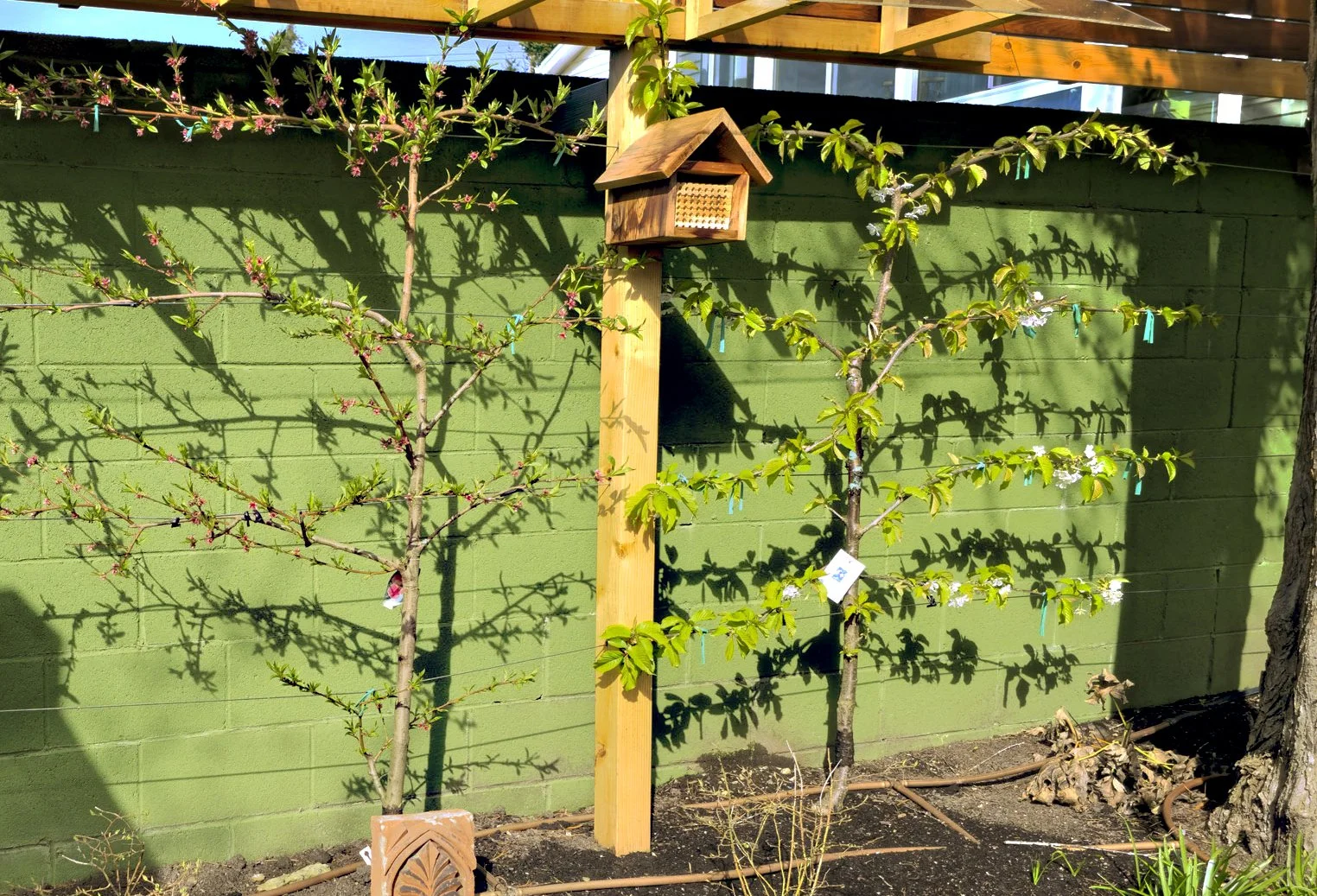
These are stone fruit horizontal multiple cordons. The tree on the left is a nectarine and the one on the right is a peach. These trees are in a backyard garden in Coastal British Columbia
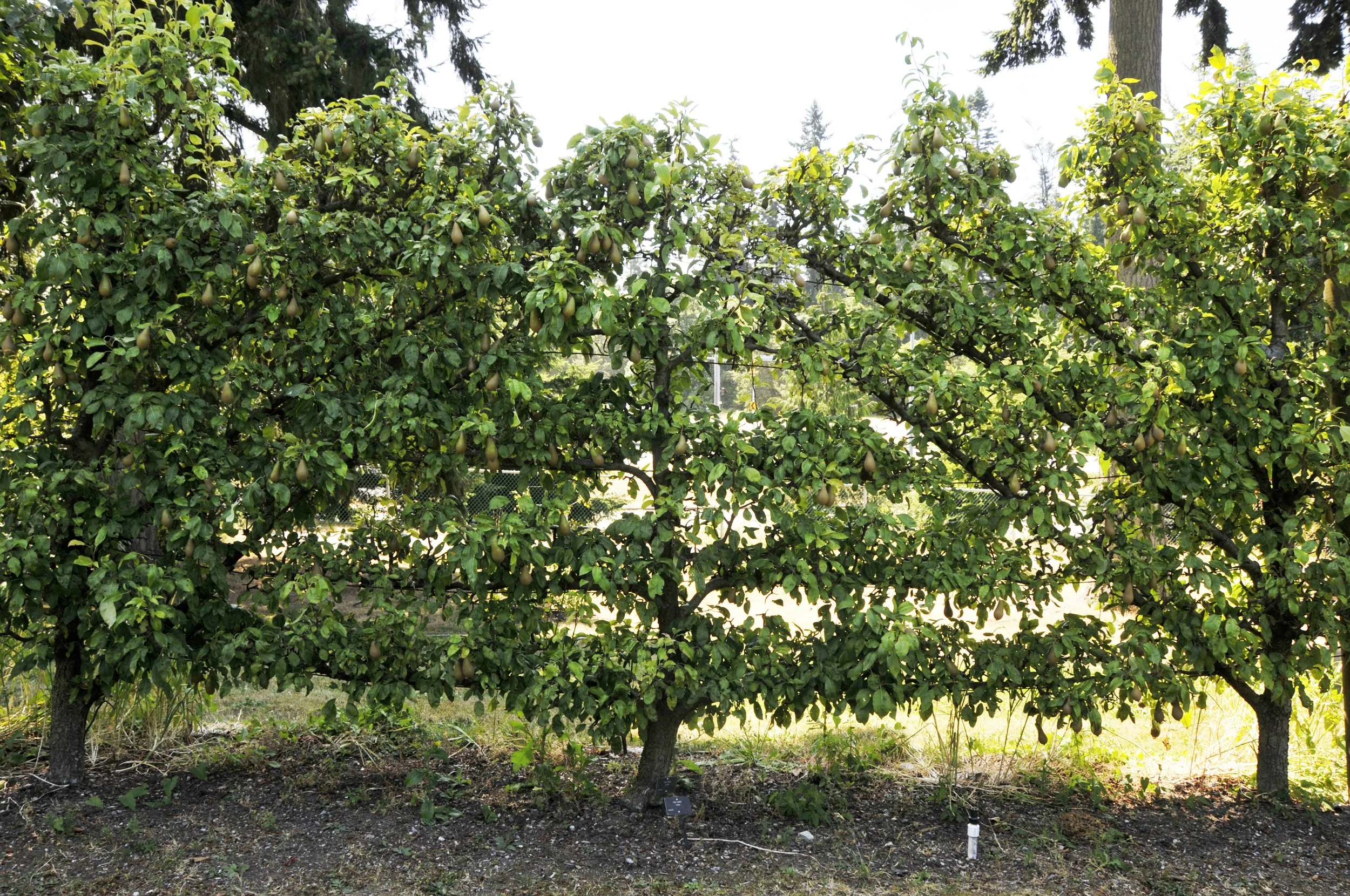
These are pear trees were in the original University of British Columbia Botanical garden espalier collection. The center tree is a 4 tier horizontal multiple cordon (Palmette) and the trees on the left and right are 4 tier oblique multiple cordons (Palmettes).
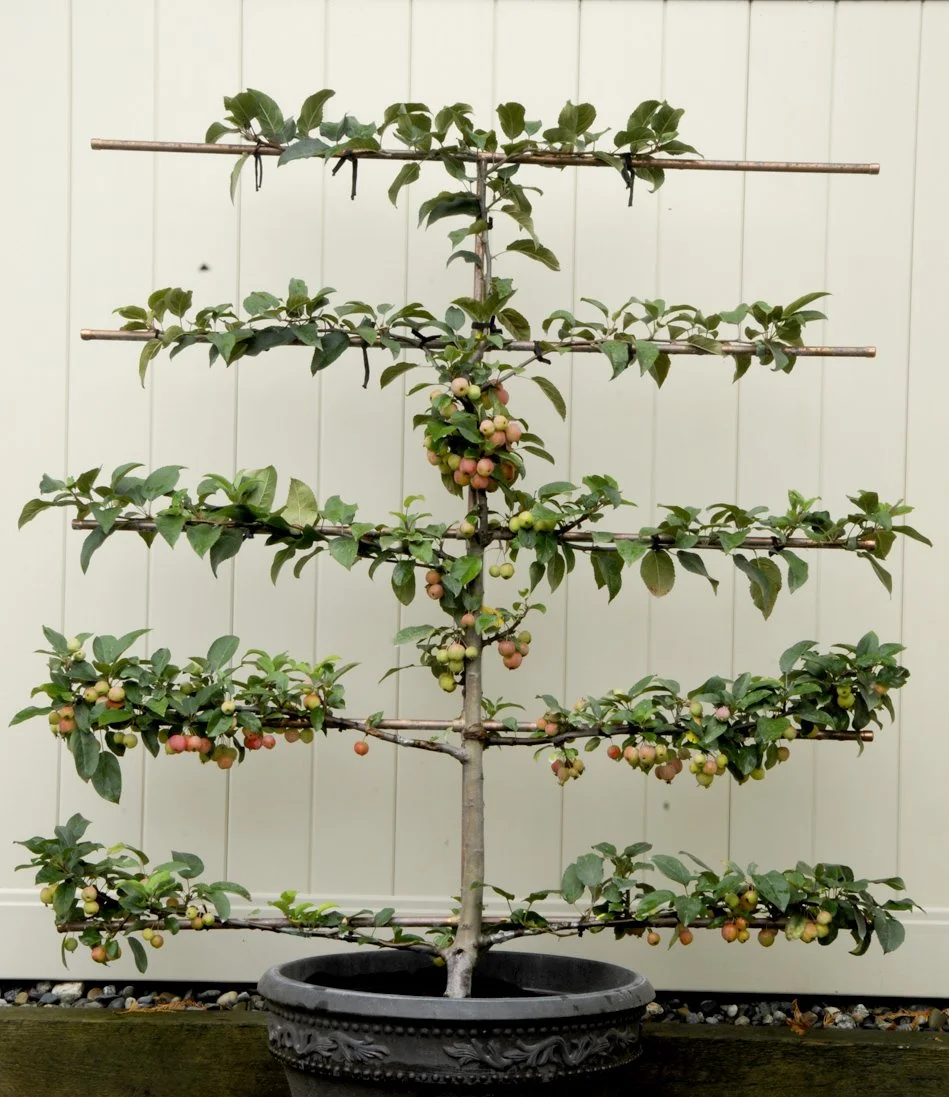
This is a Five Tier Horizontal Cordon (Multiple Palmette Horizontal). This is a Red Sentinel Crabapple. The fruit only grow to about 2 cm in diameter. It is used as a ornamental and source of pollen. I trained this tree on a copper pipe trellis in my backyard.
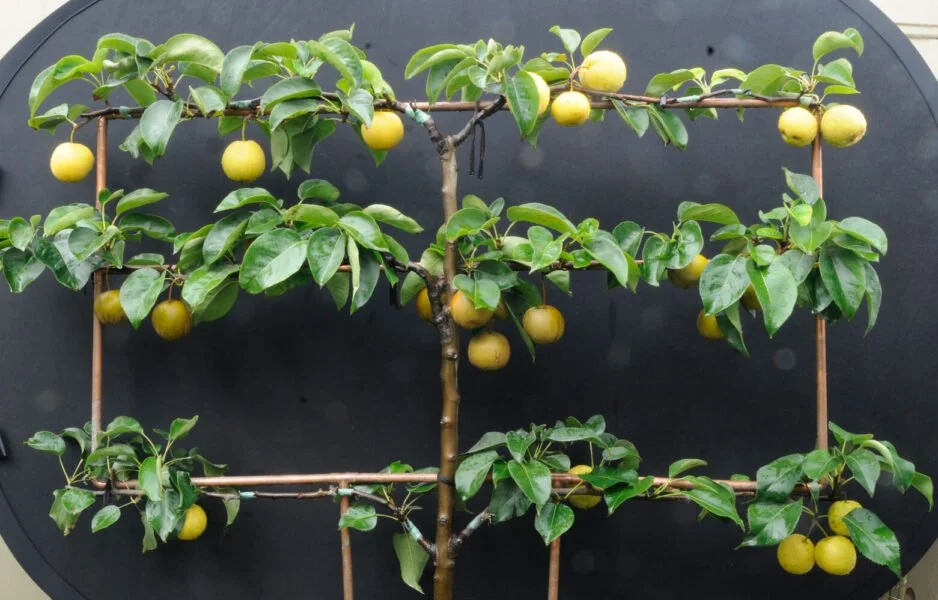
This is a three tier Horizontal Cordon (Palmette) 20th Century Asian pear that I trained this tree in my backyard on this copper pipe box trellis in a 20 gallon pot.. The tree is about 4 years old in this image. I sold it to a client 4 years ago.
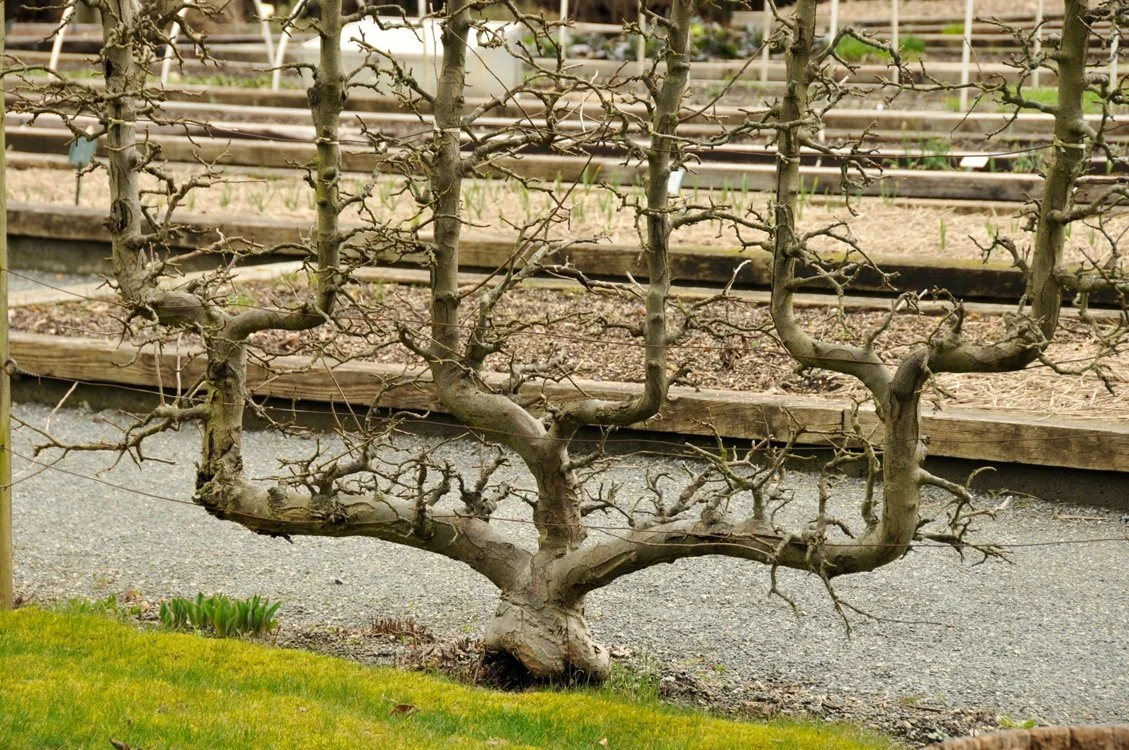
Verrier Palmette Multiple U Candelabra This tree is an apple more than 20 years of age. Multiple U trees are fairly easy to train and maintain. Very attractive and any type of fruit tree can be trained to this design. Commercial orchards around the world are adopting a version of this design called a Planar Fruiting Wall. This tree was part of the original University of British Columbia Botanical garden espalier collection.
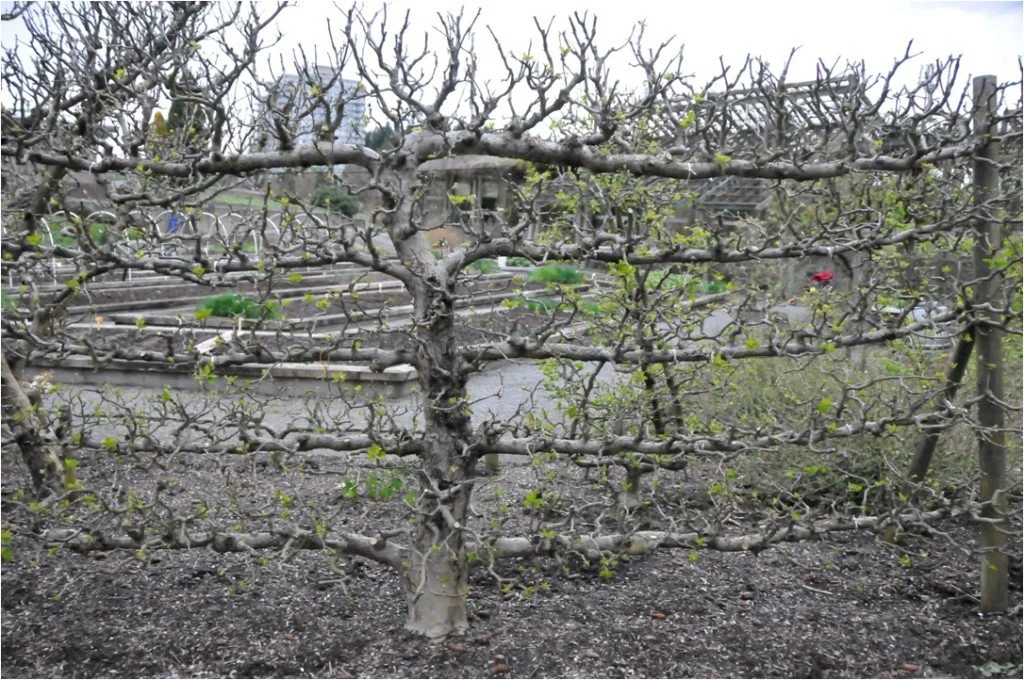
This 5 tier horizontal cordon (Palmette) apple was in the original University of British Columbia Botanical garden espalier collection. It was 15+ years old and measured 8 feet tall and 16 feet in length.
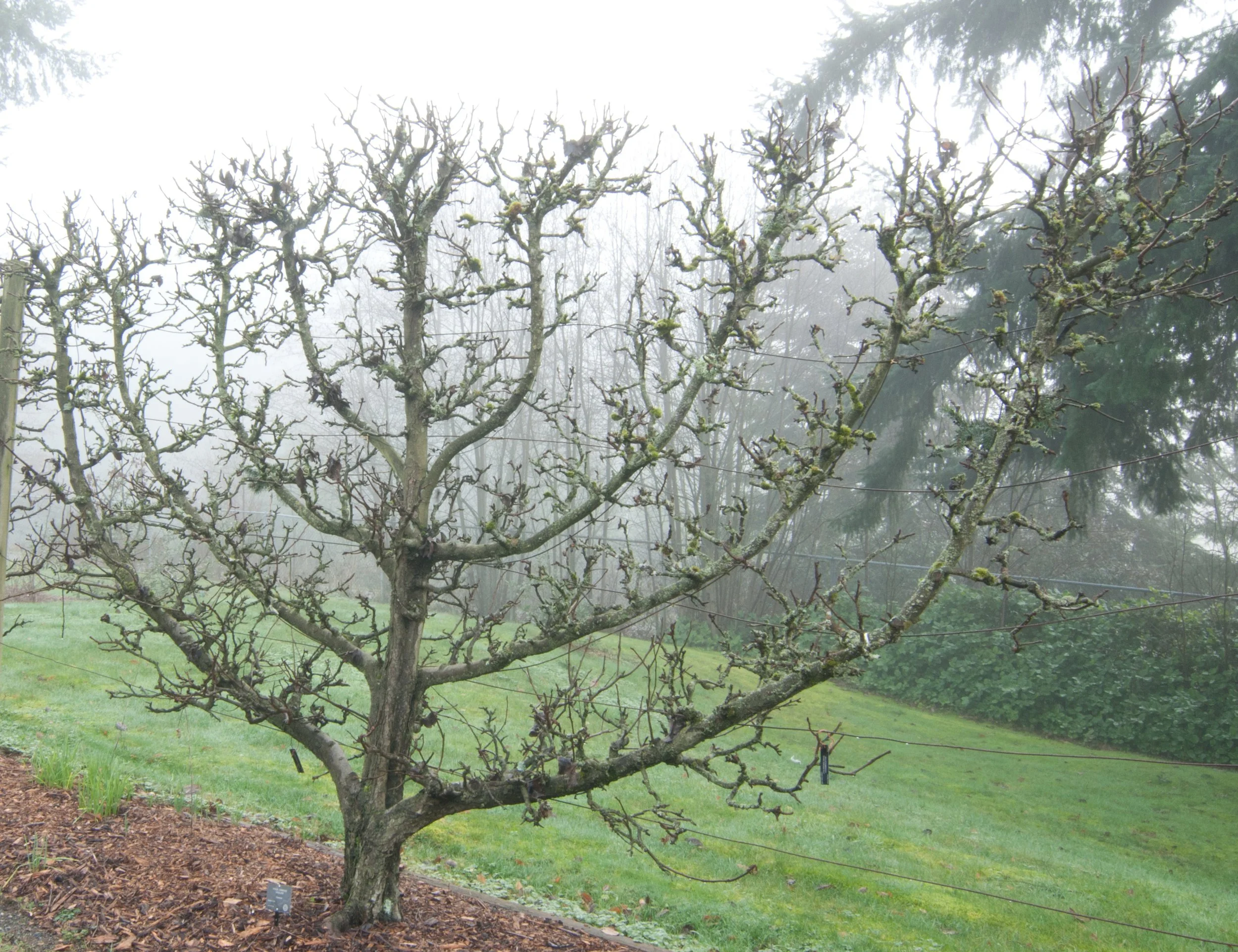
Candelabra Palmette Aurora Pear. Aurora It is a cross of Marguerite Marillat and Bartlett, developed in Geneva, NY, and released in 1964. This spectacular Candelabra tree was trained slowly using horizontal trellis wires. It was one of the trees in the original University of British Columbia Botanical garden espalier collection.
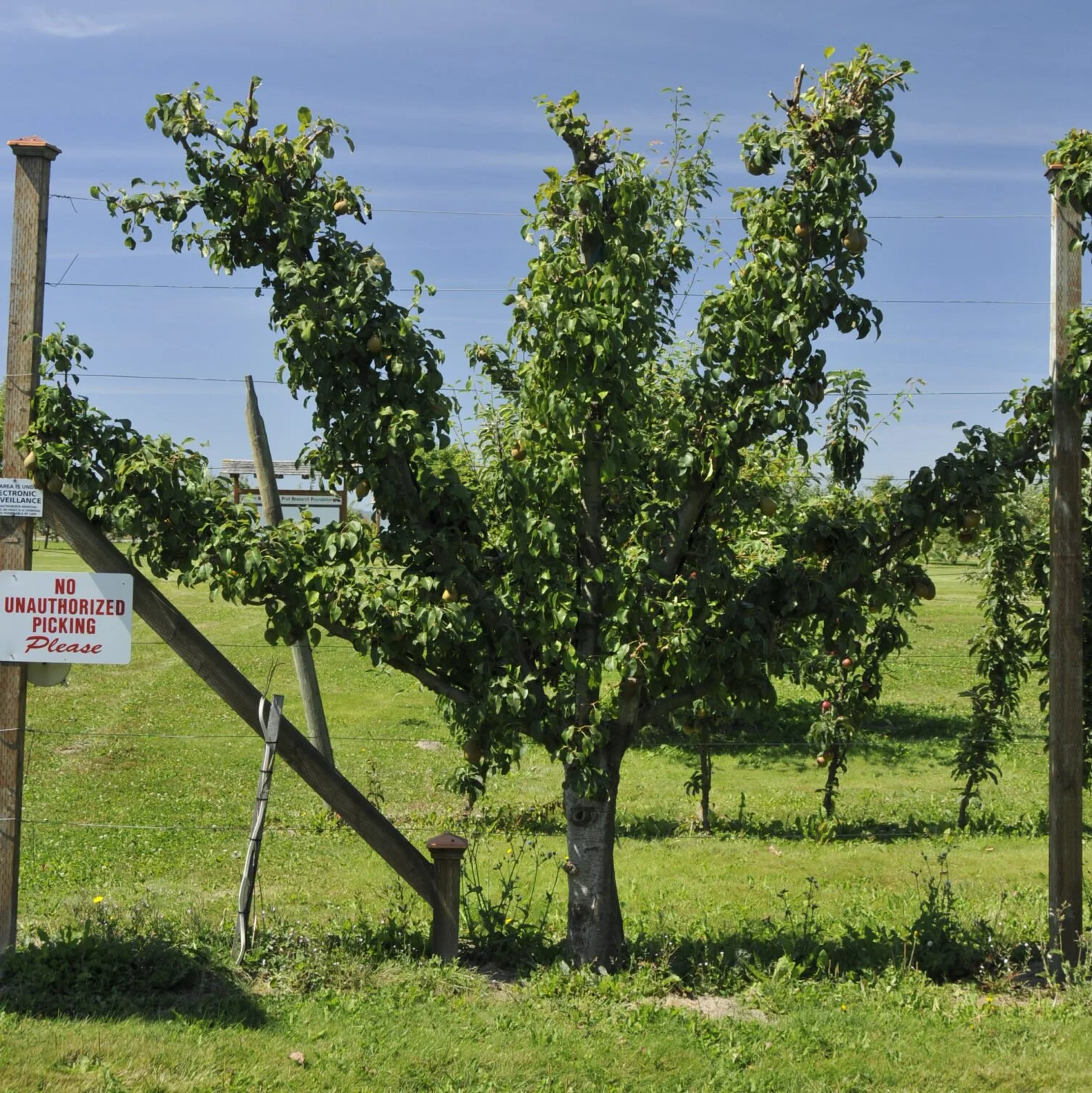
Fan Palmette This tree is a pear 20+ years of age. It is part of the espalier fruit tree collection at the WSU Research station at Mount Vernon, Washington State that is managed by NW Fruit (https://nwfruit.org/home_fruit_garden_tour_espalierpears/)
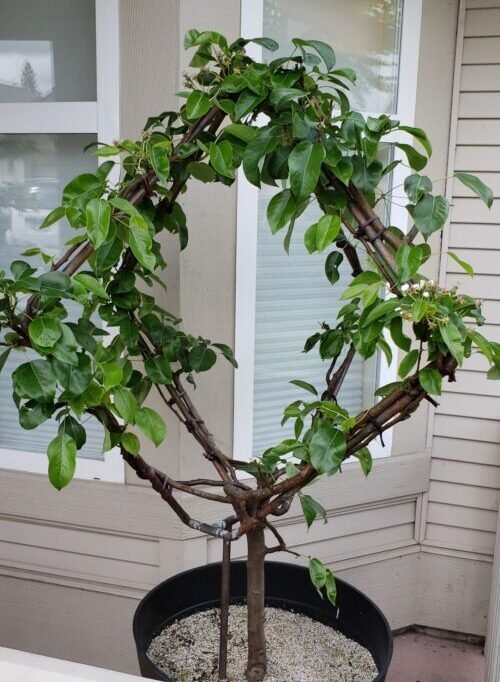
3 Dimensional Diamond This tree is trained on a copper pipe trellis. Has been trained for 5 years from a whip. It is a Red Clapps Favorite European Pear. Four leaders were trained from the trunk at 45 degree angles. At 24" all four leaders were bent 90 degrees and trained to the top where the four leaders meet. Designed and trained by Richard Hallman.
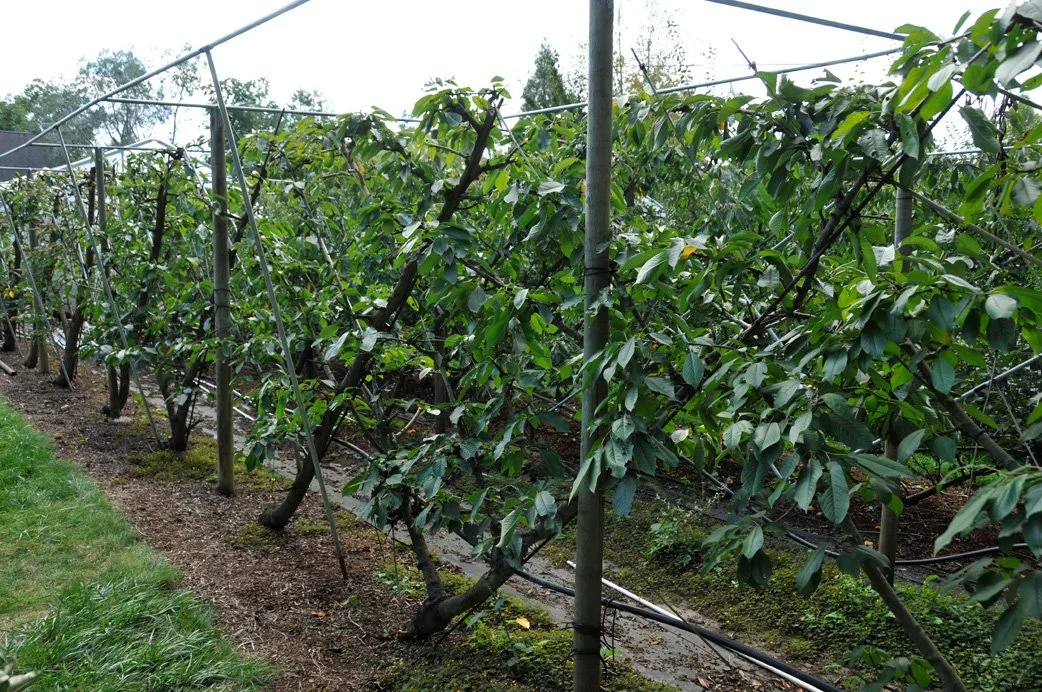
This is a sweet cherry Drapeau Marchand (Merchant Flag in English) tree form. This form is very similar to the newly developed Uniform Shoot Offset (UFO) form. The above image is in Bob Duncan's Demonstration Orchard on Vancouver Island. (Bob's website is: www.fruittreesandmore.com
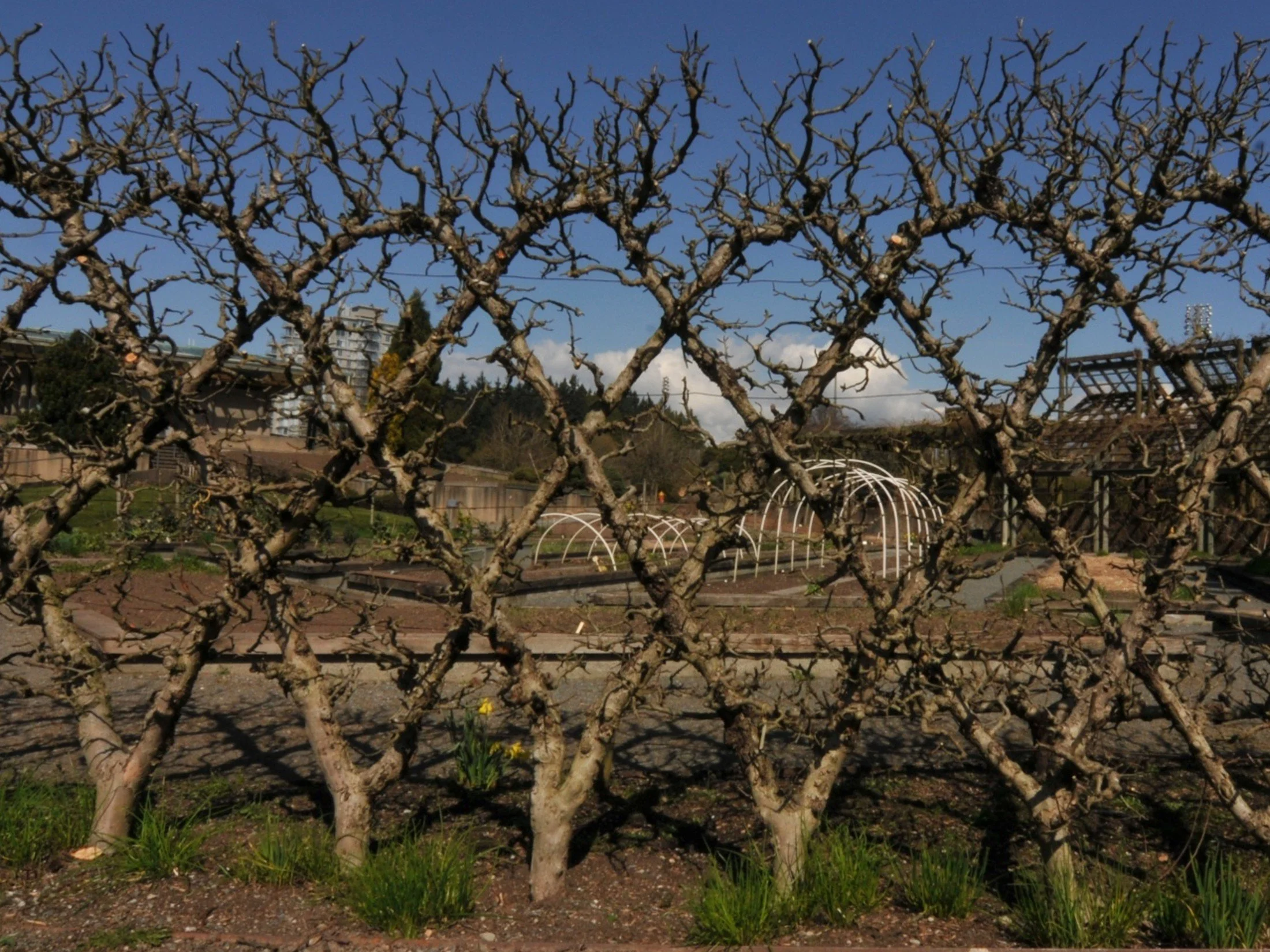
Belgian Fence Also called Losange (Diamond) and Croisillon (Cross Arm) This planting is a single variety of apple. These trees are about 20 years old. An alterative is to plant it to multiple varieties to aid cross pollination. This form is fairly easy to train but can be problematic to maintain due the crossing of branches. It is often used to develop a fence or screen. A good rootstock choice for this design is M26 or another rootstock of similar vigor. These trees were part of the original University of British Columbia Botanical garden espalier collection.
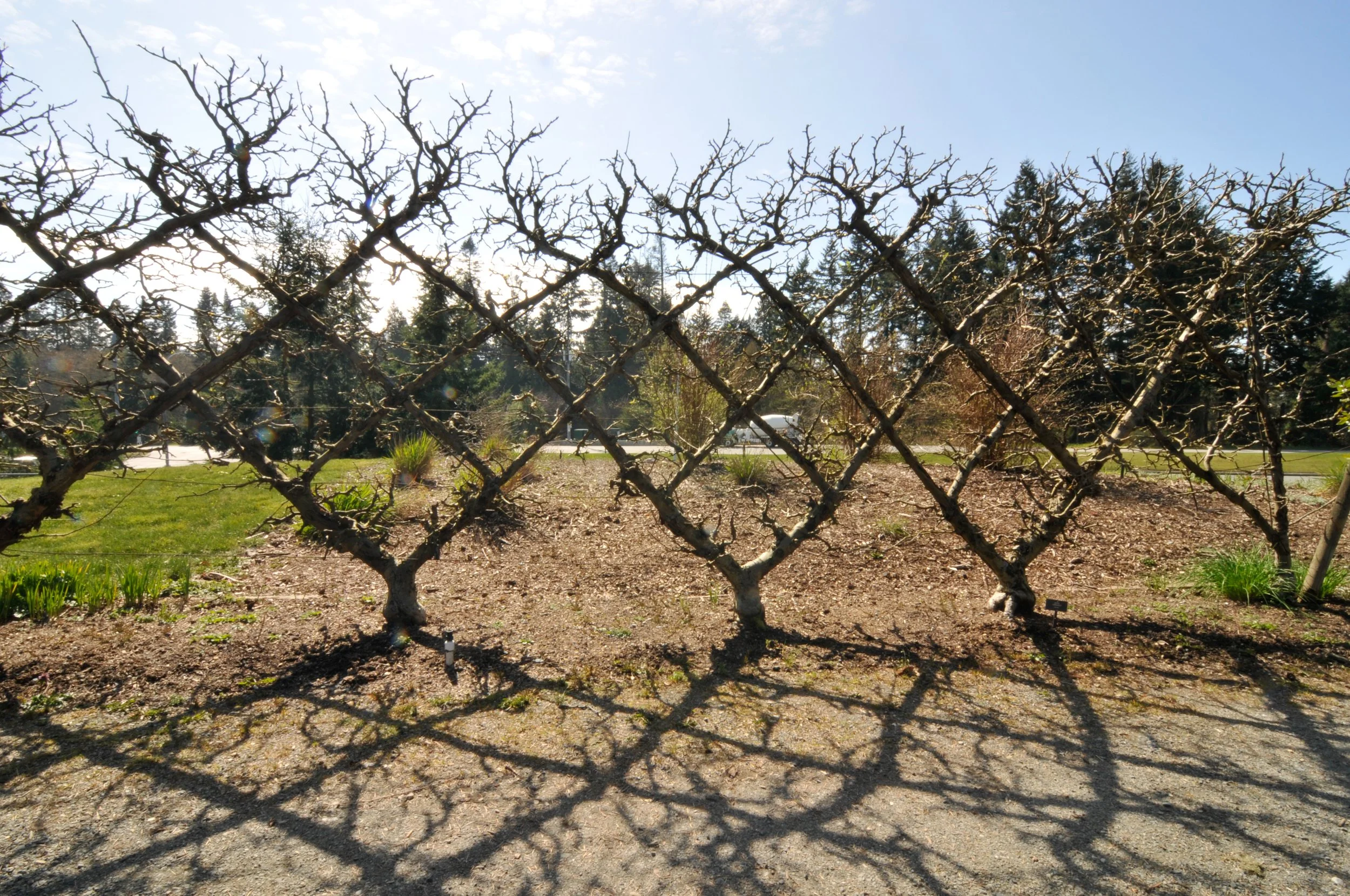
Delbard Three Crossarm (Tricroisillons Delbardin French) This is often considered to be a version of the Belgian Fence using half the number of trees. The distance between trees and angles of branches can be adjusted to the vigour of the variety and rootstock. The trees in the image are about 20 years old in the image ane were part of the original University of British Columbia Botanical garden espalier collection.
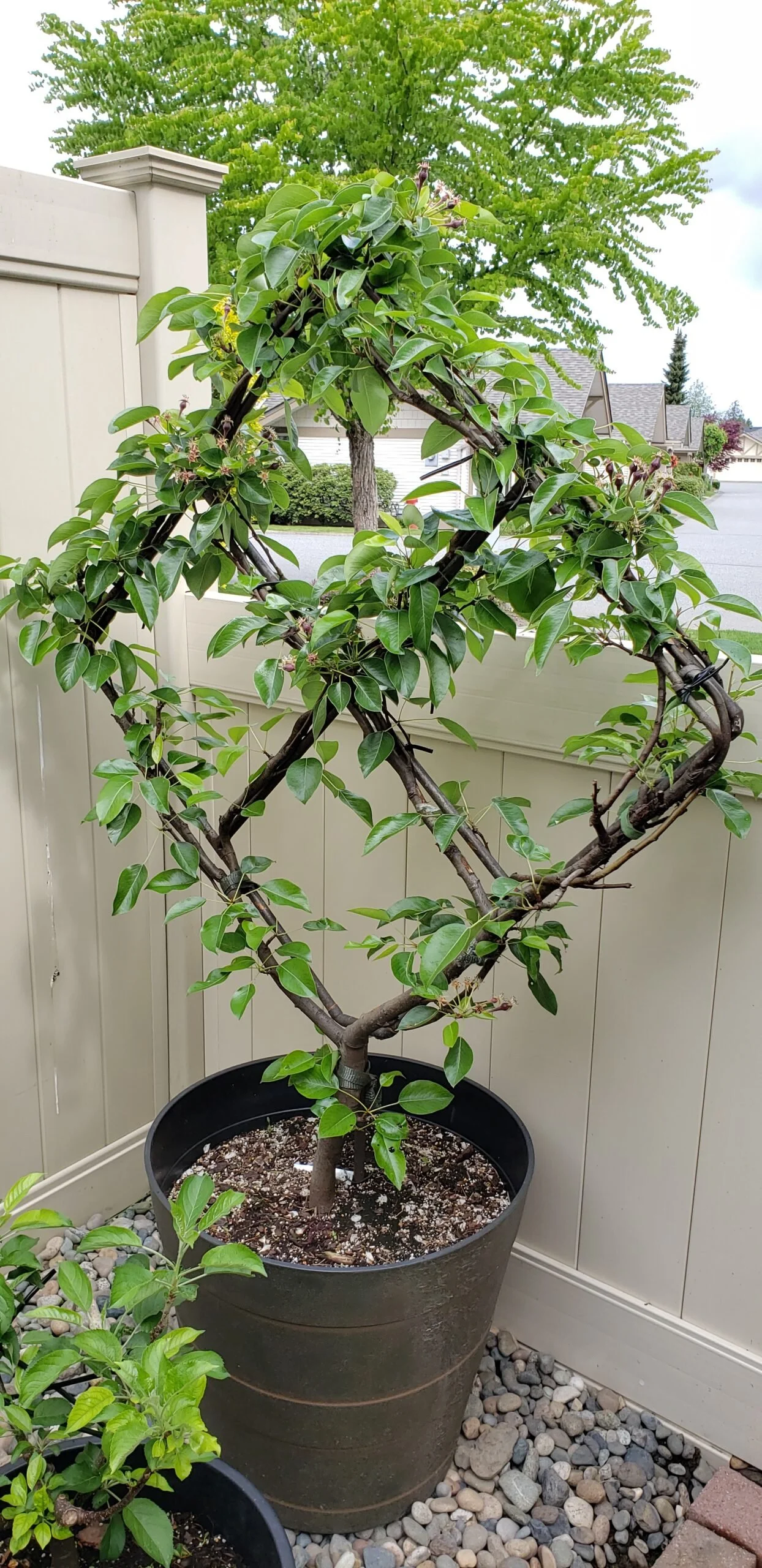
2 Dimensional Diamond This tree is trained on a copper pipe trellis. Has been trained for 4 years from a whip. It is a Red Clapps Favorite European Pear. Two leaders were trained at 45 degrees from the trunk and tipped just past the 12" mark to produce lateral growth. One lateral was selected for training at 90 degrees and another was trained to continue on for a further 12" and then it was bent at 90 degrees to produced the design. Designed and trained by Richard Hallman.
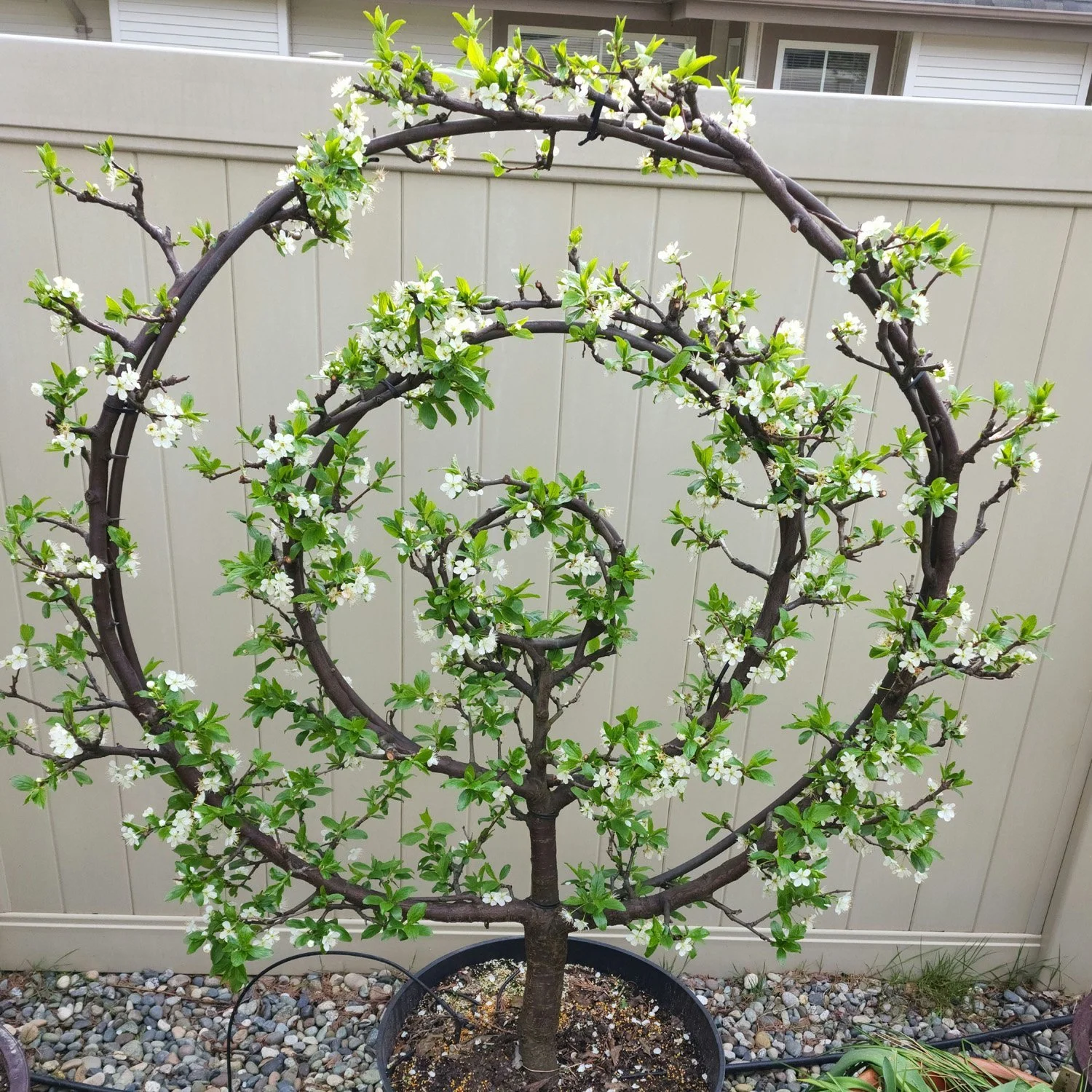
Concentric Palmette (Palmette Concentrique in French) I have nicknamed this design "Circle in Circle". The tree is 4 years old in this image, I trained it in my backyard from a whip. This is an Italian Prune Plum. I am currently training an apple and a pear multi variety trees to this design. This tree was in a 20 gallon pot. I sold this tree to a client and it has now been planted in their garden in Coastal British Columbia.
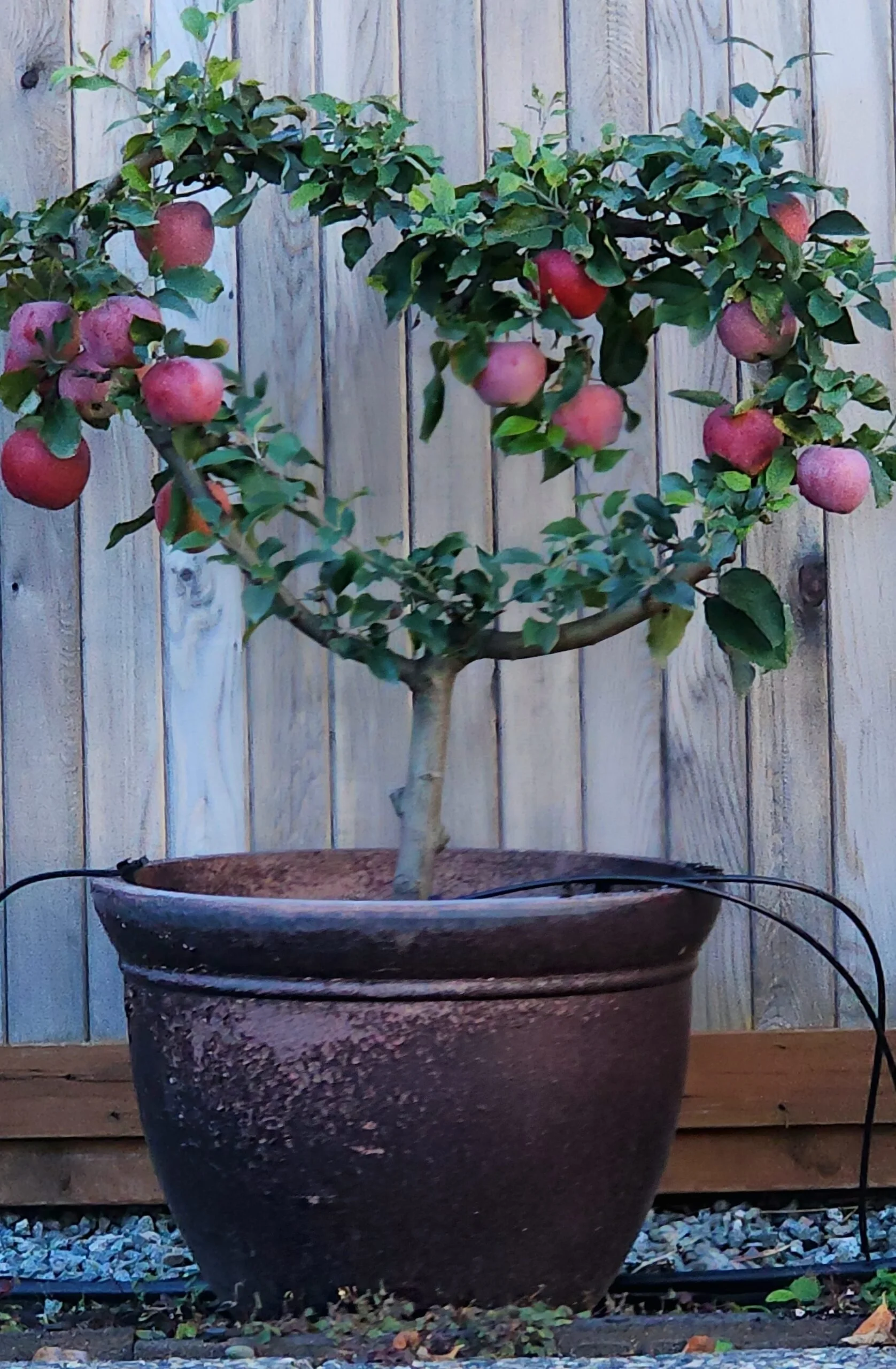
I trained this Florina apple tree into a heart for my Granddaughter. The rootstock is M9. The tree is 4 years trained from a whip. Florina has high Apple Scab resistance making it an excellent choice for the wet west coast weather we live in.
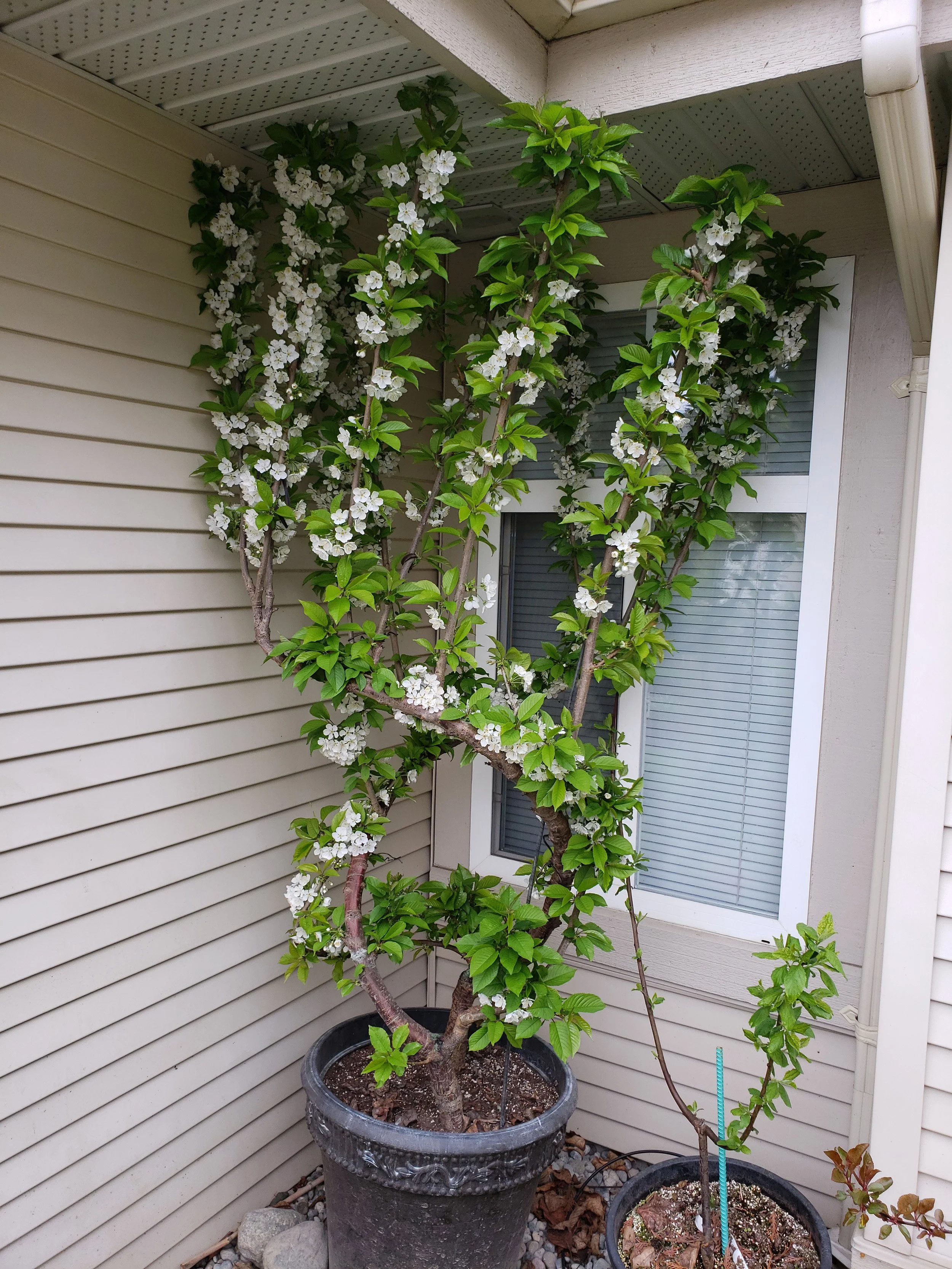
Sweet Cherry Double Tree Double Spiral The two seperate trees are Lapins and Raineer. Lapins is self pollinating and it will also pollinate Raineer. The tree has been pushed back under the eve of my house as I live near Vancouver, British Columbia, and area that receives 60" (1524 mm) annually. There are several common diseases in this region that severely damage unprotected Cherry, Peach, Apricot and many Plums.
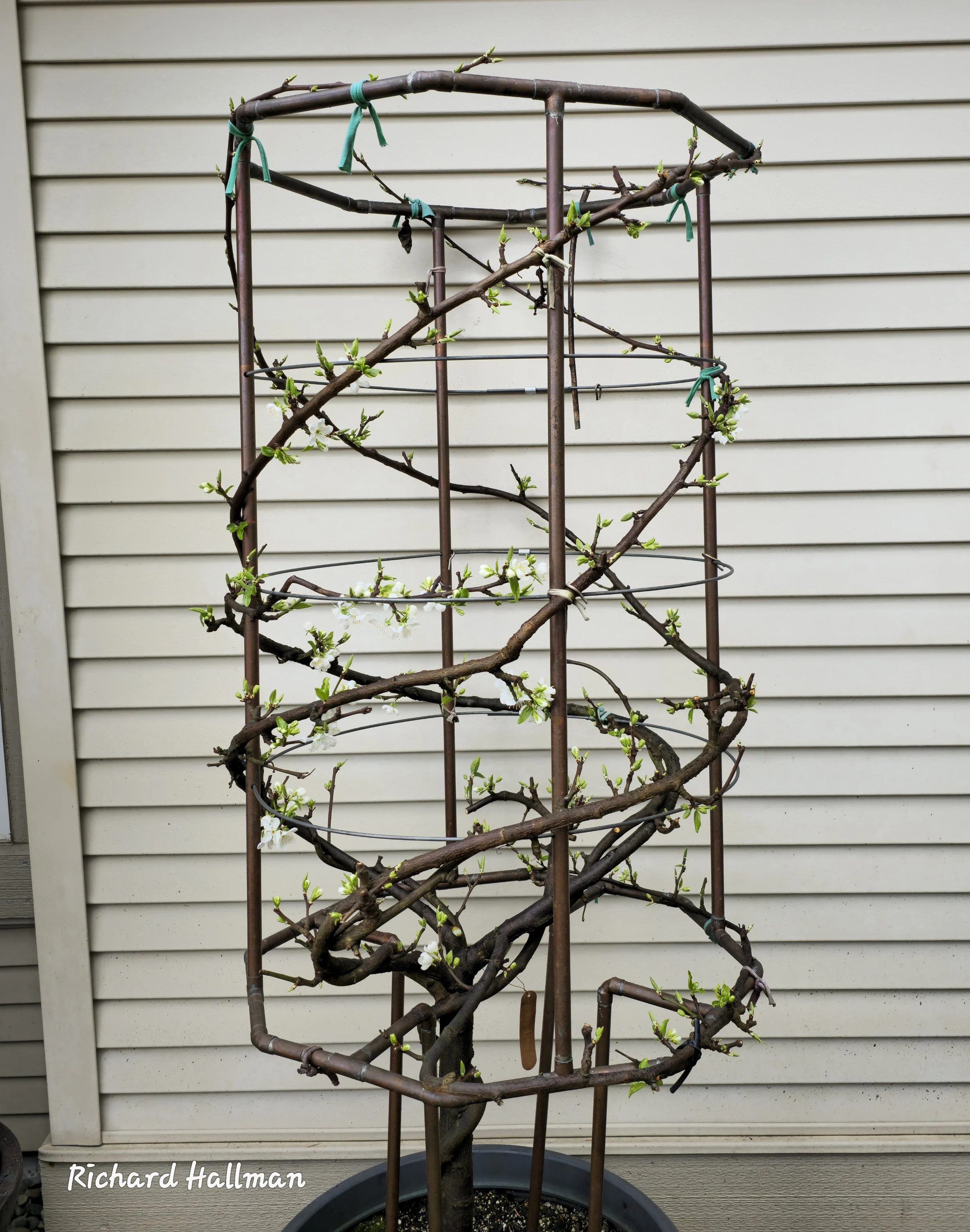
Double Spiral Brooks Plum This European Plum tree is 4 years old in this image trained on a copper pipe trellis. This form is sometimes called a Goblet. This tree has produced 25 large plums last year. Note that I wrapped some branches around the trunk and other branches of the tree. This is a technique I often use for interest and to fill in areas without lateral branches. in time the wrapped branch and the trunk will grow together. This is a very old and successful technique.
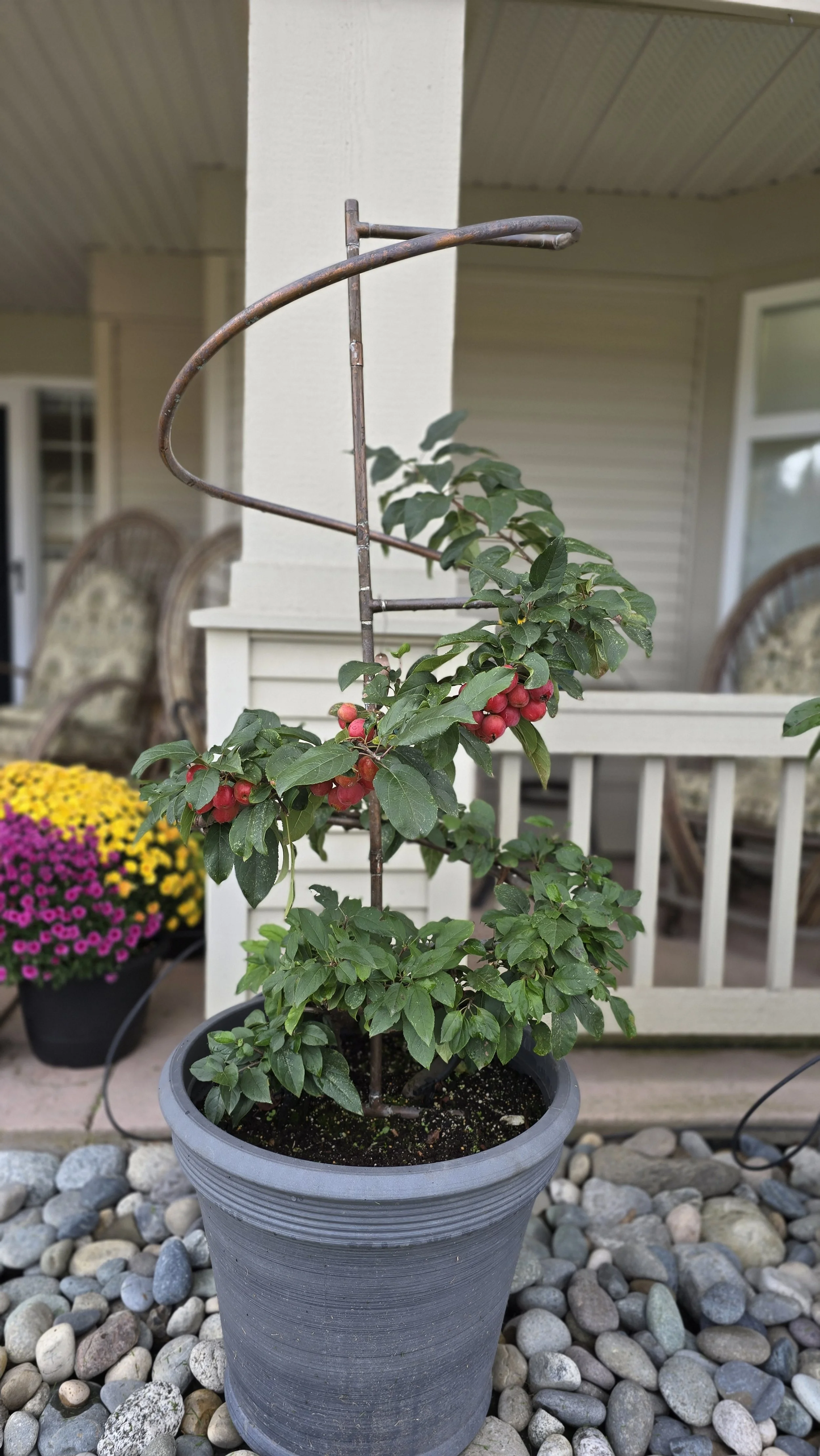
Single Spiral Crabapple This is a Red Sentinel Crabapple. This variety is usually grown as an ornamental. If you do not want to bother with insect and disease management that most tree fruits require, try of these small fruited crabapples. Ornamental crabapples are usually selected for disease resistance and the fruit are so small that Codling Moth damage is not obvious, They are fun to train, spectacular annual ropes of blossoms and attractive fruit that stays on into the winter or until wildlife eat them.
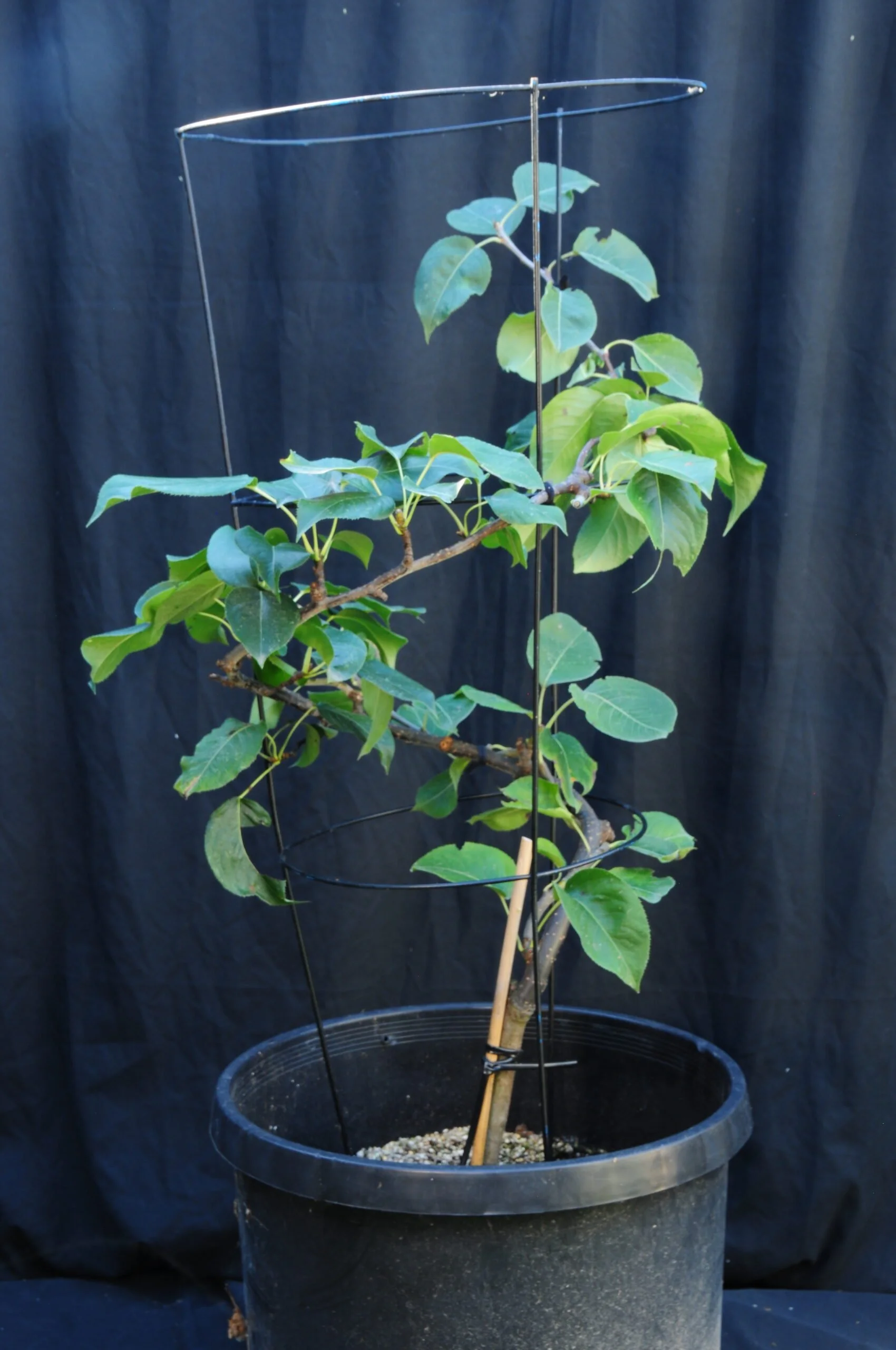
Single Spiral Asian Pear This Nijisseiki Asian Pear (also called 20th Century) works very well for training into a wide variety of designs. I trained this spiral in my backyard. The spirals I train are growing at a 45 degree angel, the same angle as an oblique cordon and an ideal angle for managing vigor and fruit production.