
What is an Espalier Fruit Tree?
Meaning of the word “Espalier”
Espalier fruit tree has several meanings depending on what part of the world you live in, your experiences, books and web pages you have read and online videos you have watched. My view is arguing whether a tree design is an espalier, a cordon, a palmette, a candelabra, a goblet or any of the other designs is a waste of time.
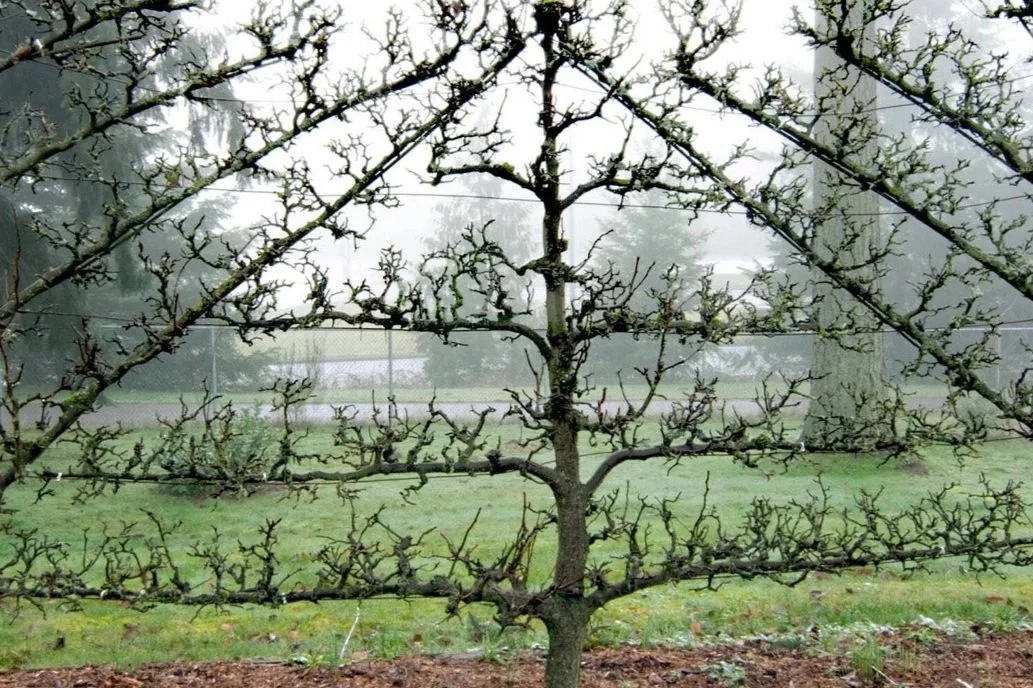
“Espalier Fruit Tree” is used on this website as an inclusive term for all fruit trees intensively trained into geometric forms. The commonly used names for designs included are: Espalier, Cordons, Fans, U’s, Stepovers, Belgian Fence, Palmettes, Goblets, Spirals and all the other designs (patterns, forms) used in this website.
Espalier Fruit Trees are:
grown in gardens or permanently in containers
an innovative way to grow your own fruit in small spaces
a way to produce fruit fresh from you garden all summer and fall
grown on roof top gardens, patios and balconies
Training, pest control and harvesting are done with out a ladder
Creat dramatic landscape focal points or groups of trees
For spring blossoms, summer foliage, fall fruit and winter structure
As a scientific pursuit - a great way to learn about plant physiology

Drawing from a book written in the 1800’s
Espalier History
Espalier tree training techniques were developed well before the discovery of the plant hormones that are the reason espalier training works. This was before the availability of dwarfing rootstocks for apples and pears that make it much easier to keep the trained trees small.
Gardeners relied on skillful pruning, branch-bending/tieing, angle/orientation, root restriction ( using pots or tubs), forced microclimates (walls/orangeries), and propagation techniques to create small, productive espalier trees. These methods developed by trial and error, close observation and documentation in monastic and royal gardens (notably Versailles) and were spread by manuals, nursery catalogues, horticultural societies, apprenticeships and illustrated plates from the 16th through the 19th centuries.
During the1800’s espalier gardeners understood that there was something inside the trees causing them to grow the way they do but did not what it was. Charles Darwin and his son did some experiments about 1880 proving there was a substance moving from the apical bud down through the growing shoot.
The identification of the plant hormones clarified why and how plants grow as they do.
Auxin and Gibberellins were identified during the 1930’s, Cytokinin in the 1950s. The most recent plant hormone to be discovered is Strigolactone in1966.
Today, with knowledge of the plant hormones, what they do and how they interact is used to design and train commercial orchards and espalier fruit trees in gardens around the world.