Temperate Fruit Trees for Training into
Espalier Fruit Trees
Selecting trees for your espalier fruit tree project
Note: recommendations for specific varieties and rootstocks that your should select for your espalier project are not included on this site. This may be what you are looking for but, I recommend a different approach:
choosing rootstocks do well in your location and will grow to be the height and width you want you tree to be. I will list the most common rootstocks being used for Espalier fruit trees. The rootstocks that are the best for a specific espalier form and size of tree vary around the world. Check with local nurseries and if possible, people already growing and training espalier fruit trees near you.
The choice of varieties requires some of the same research as for rootstocks with the addition of your personal preference of the type of fruit you like to eat. If you favorite fruit is not grown or recommended for you area, you may still be able to grow it with some extra work and cost to provide you trees with protection.
local climatic information is critical when choosing Varieties (cultivars) and rootstocks. Research the following if they apply:
in areas with high rainfall choose varieties that are resistant to fungal or bacterial diseases and/or plant to protect them from infections
Choose rootstocks that will produce the size of tree when combined with your chosen variety suitable for the form you have chosen, and space you have for this tree at maturity.
in an areas with very cold winters, choose suitable winter hardy varieties and rootstocks
in a subtropical areas with very short mild winters choose suitable low chill varieties.
Growing your own trees
Finding Trees
Local nurseries
Public events
Online sources
Variety(cultivar)
suitability of cultivar and rootstock for espalier forms
multi variety trees
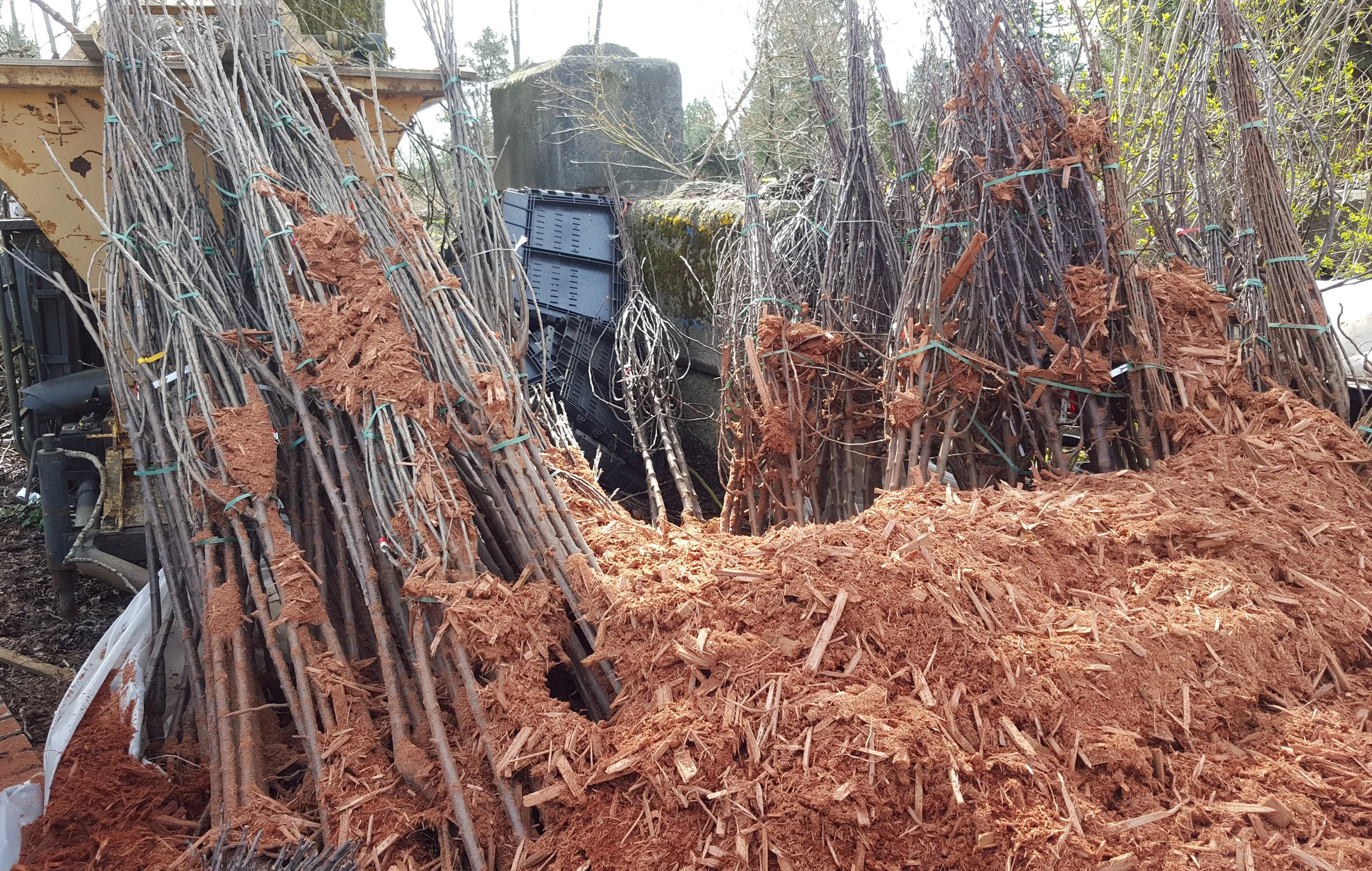
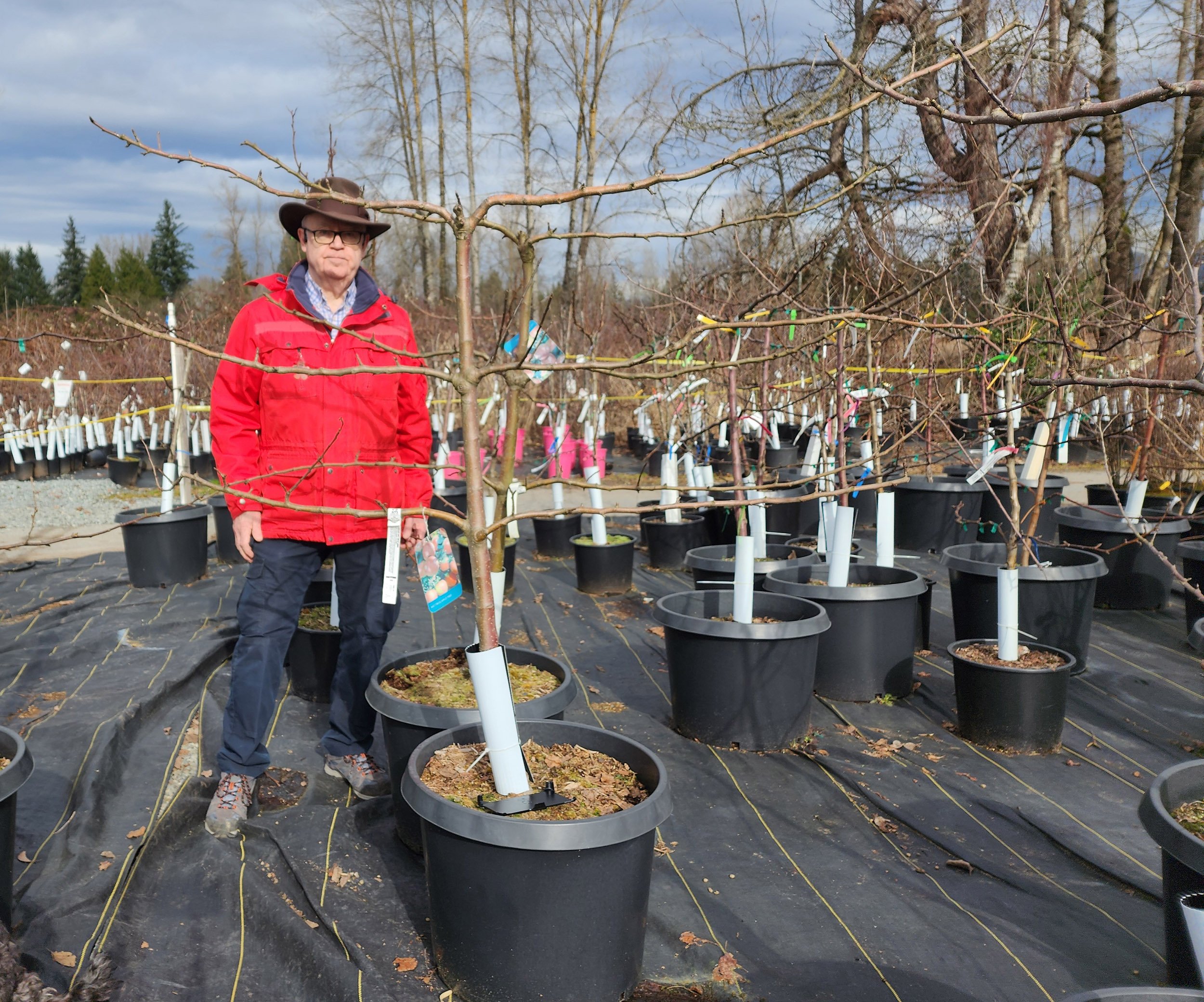
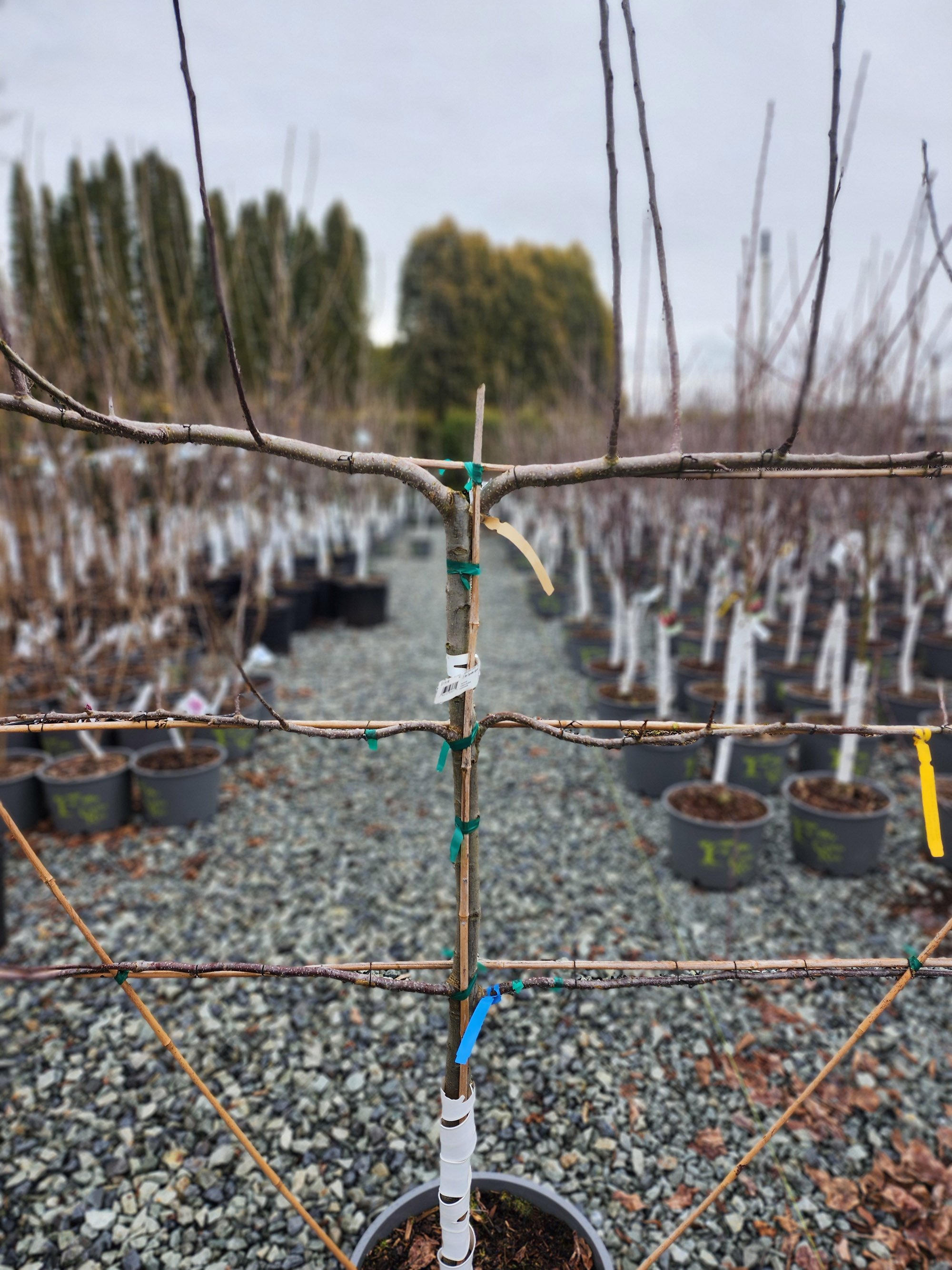
pre trained trees
Whip and older, larger trees
Multi variety trees
Rating of trees that I think to be easiest and those that are more difficultds. Some trees will require close monitoring and use of some specific techniques.
Climate - tree right for your zone
Disease resistance - cultivar and rootstock
Pollination requirements
All temperate and many subtropical fruit trees can be shaped into any espalier form. Don't trust claims saying some trees can only be shaped in a few ways.
Temperate Deciduous Fruit Trees
The trees most commonly espaliered and used in most of my examples on this website include:
All types of pears (Genus Pyrus)
European Pears (Pyrus communis)
Asian Pears (Pyrus pyrifolia). Other common names: Nashi pear, Japanese pear, Chinese pear, Korean pear, Taiwanese pear, apple pear, zodiac pear, three-halves pear, papple, naspati and sand pear.
Most Genus Prunus
Sweet cherries (Prunus avium)
Sour Cherries (Prunus cerasus) Common names - acid cherries, pie cherries and tart cherries.
Asian Plum - (Pruns salicina). Common names include Chinese Plum, Japanese Plum
European Plums - (Prunus domestica). Also known as Common Plum and Prune Plum.
Apricot (Prunus armeniaca)
Peach and Nectarine (Prunus persica)
Almond (Prunus amygdalus)
Beach Plum (Prunus maritima)
Nanking Cherry - (Prunus tomentosa). Common names include Nanjing cherry, Korean cherry, Manchu cherry, downy cherry, Shanghai cherry, Ando cherry, mountain cherry, Chinese bush cherry, and Chinese dwarf cherry.
Fruiting Quince (Cydonia oblonga)
Shipova (xSorbopyrus irregularis). A cross between Mountain Ash and Euroopean pear (Pyrus communis x Sorbus aria)
Medlar (Mespilus germanica). Common Medlar.
Hawthorns (Crataegus spp.).
Common names include hawthorn, quickthorn, thornapple, May-tree, whitethorn, Mayflower and hawberry
Mayhaw (Yellow -Crataegus opaca and Red - Crataegus aestivalis). These are the best know of the edible Hawthorn species, the berries of many other have medicinal qualities. (Crataegus spp).
All Hawthorns can be espaliered.
Many Figs (Ficus spp)
Common Fruiting Fig (Ficus carica)
Many Mulberries (Morus spp.
Common Mulberry (Morus alba). Other common names include White and Black Mulberries
Persimmon (Diospyros spp.) - Note: Persimmons are growing in warm temperate and sub tropical regions.
American Persimmon (Diospyros virginiana). Common names - Common Persimmon, Date Plum, Eastern Persimmon, Jove's Fruit, Possum Apples.
Asian Persimmon (Diospyros kaki)
Cornelian cherry (Cornus mas). A member of the dogwood family (Cornaceae).
Pawpaws - (Asimina triloba). common names: pawpaw, custard apple, dog banana, Indian banana, false-banana, pawpaw-apple and fetid-shrub.
Heritage Varieties
A lot of gardeners world wide are interested in Heritage varieties that are no longer grown in commercial orchards. They number in the thousands for apples and many for all the other tree fruits.
Caution: Most old apple trees contain latent viruses. These viruses do not affect the growth or productivity of the trees, however, if these old drees are a source of scionwood, the latent viruses my be a problem for rootstocks or other cultivars. An example is the apple rootstock G16. This rootstock is very sensitive to latent viruses and in apple and should only be propagated with virus-free scion wood on top.
A few Heritage Apple Links
Development of RT-qPCR assays for the detection of three latent viruses of pome. Science Direct
Apple latent viruses - Michigan State University
Heritage Apple Project - Haliburton County Master Gardeners
The Search for "Lost" Heritage Apples - Apple Search
Pollination Requirements
Fruit Tree Pollenizers (Pollenisers) and Pollinators
remove ageof tree information
Typically it’s the age of the wood that determines when a blossom bud develops that can produce fruit. Its common for new grafts to set fruit the first year. This is important to know before you begin pruning any variety because you want to preserve your fruit buds:
Nectarines (Prunus persica nectarina) – fruit mainly on 1-year old wood. Self-fertile, only varieties with ‘Hale’ in their parentage will require another variety for pollination. Nectarines are really just smooth peaches without the ‘peach fuzz’.
Peaches (Prunus persica) – fruit mainly on 1-year old wood. Self-fertile, only varieties with ‘Hale’ in their parentage will require another variety for pollination.
Plums, European (Prunus domestica) – fruit on long-lived spurs on 2-year old wood and older. Most varieties require a suitable pollinator, but some varieties, such as Green Gage, and Damsons are self-fertile.
Plums, Japanese (Prunus salicina) – fruit on 1-year old wood, and on short-lived spurs on older wood. Most varieties require a suitable pollinator, but some varieties, such as Santa Rosa are self-fertile, while varieties such as Mariposa are partially self-fertile…
Quinces (Cydonia oblonga ) – fruit on current season’s new growth. Self-fertile.
Cherries, Sweet (Prunus avium) – fruit on 1-year old wood and older on branches and on long-lived spurs. Some varieties are self-fertile, while others require a pollinator. Popular red cherry is the Stella variety, and dark cherry is the Lapin variety, both are self-fertile.
Cherries, Sour (Prunus cerasum) – fruit on 2-year old wood. Self-fertile. The popular dark-red sour cherry is the Morello variety.
Figs (Ficus carica) – fruit at the base of current season’s new growth, but some varieties crop twice a year and also produce an early breba crop on the tips of 1-year old wood. Self-fertile.
Apples (Malus spp .) – most apples fruit on spurs on 2-4-year-old wood, some fruit on tips of short side branches. Most varieties require a suitable pollinator, but some varieties, such as Golden Delicious, Red Fuji, and Red Jonathon are all partially self-fertile. Apples are wind pollinated.
Dennis
Kent, wa
How close do pollinizers need to be?
A pollenizer (or polleniser), sometimes pollinizer is a plant that provides pollen. The word pollinator is often used when pollenizer is more precise.
Pollinator or Pollinizer – What’s in a word?
If pollination is a concern it is easy to insert a grfe in the spring or a chip bud graft in the summer:
Timing?
Picture of an inserted bud stating the cultivar of the tree and chip or whip.


What are latent viruses?
Latent viruses are those that can infect a plant but do not cause immediate or obvious symptoms, allowing them to persist and spread unnoticed.
Examples in fruit trees:
Apple chlorotic leaf spot virus (ACLSV): One of the most widely distributed viruses of fruit trees, often latent in most commercial apple and pear varieties.
Apple stem pitting virus (ASPV): Can cause pitting and grooving, epinasty (downward bending of leaves), and decline, though it is often latent in most commercial apple cultivars.
Apple stem grooving virus (ASGV): Can cause chlorotic leaf spots, stem grooving and pitting, union necrosis, and swelling above the graft union, but is often latent.
How they spread:
Latent viruses are primarily transmitted when a virus-infected scion (a twig or bud used for grafting) is grafted onto a susceptible rootstock.
Why are they a problem?
Economic impact: Reduced fruit quality and production yields.
Unintentional spread: The lack of obvious symptoms on infected mother plants makes it easy to spread the virus unknowingly through propagation.
Mixed infections: These viruses can occur individually or together, and can cause diseases in other fruit crops.
Other viruses in fruit trees:
Plum pox virus (PPV): Causes "sharka" disease, a devastating disease of stone fruit trees worldwide.
Prunus necrotic ringspot virus (PNRSV) and prune dwarf virus (PDV): Frequently found in mixed infections on stone fruit hosts.
Cherry green ring mottle virus (CGRMV):
Do some research into the following decisions:
Select the type of tree you want to grow - apple, pear, peach, plum etc.
Select a variety
Select a rootstock that matches the size you want your tree to be.
Locate a nursery that sells the type of tree you want and order if necessary
Grafted trees
Bareroot
Container grown
Bareroot recently planted into a container
Multi grafted pretrained
Tree age