
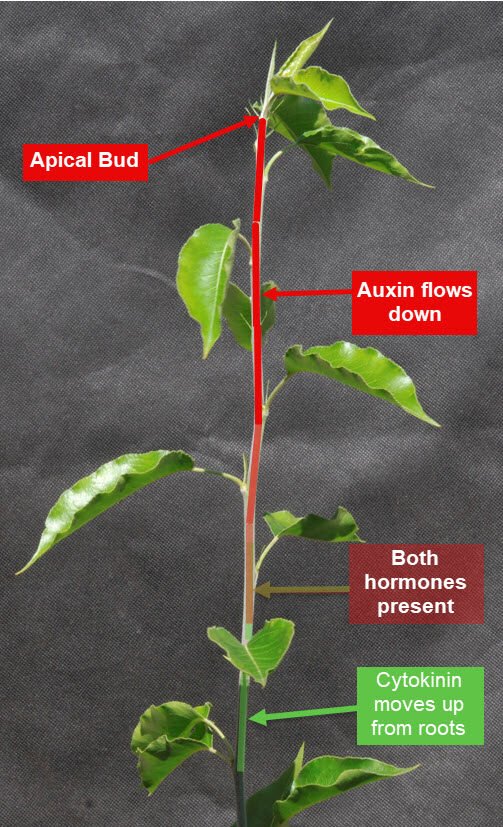
The time frame for this auxin redistribution and the resulting bending is generally relatively quick, often occurring within a few hours. The exact speed can vary depending on factors like the species, the age of the shoot, and the intensity of the bending.
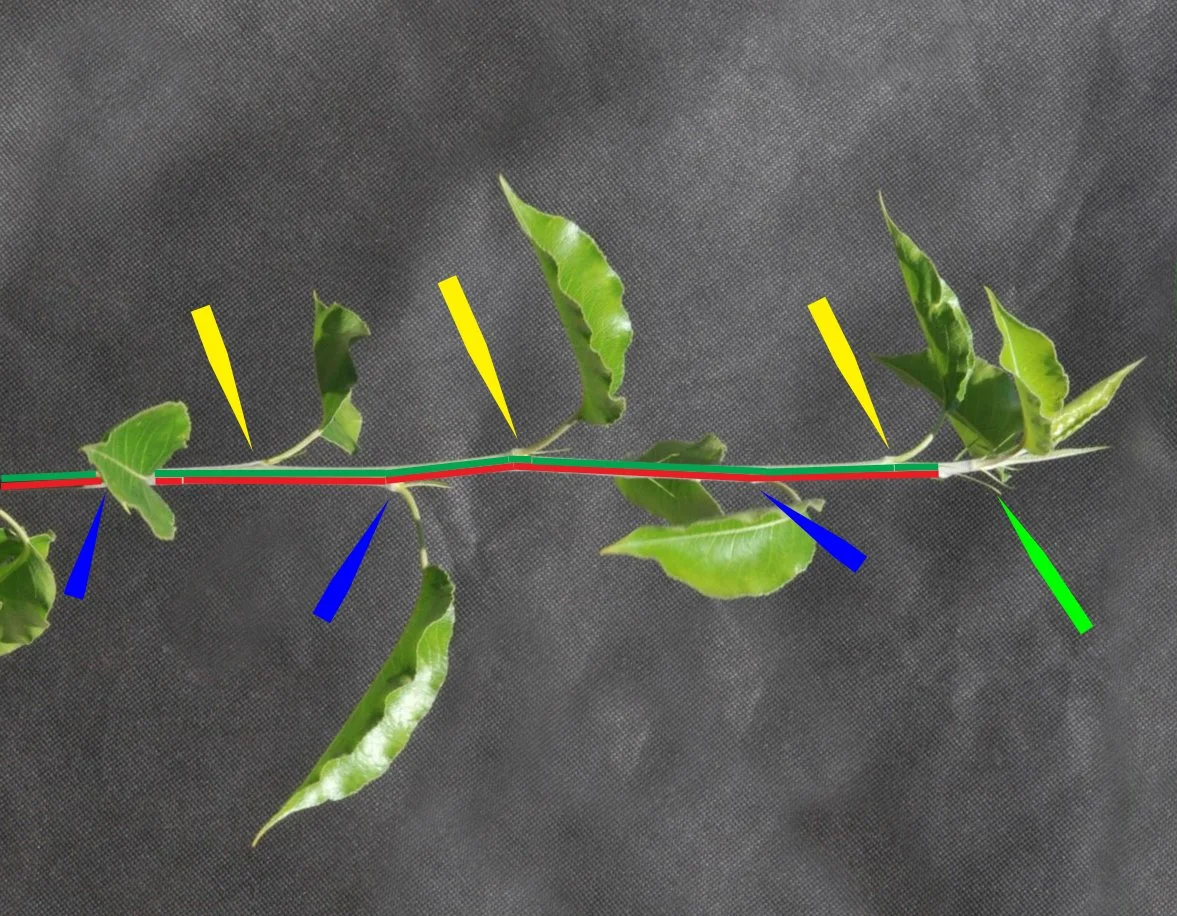
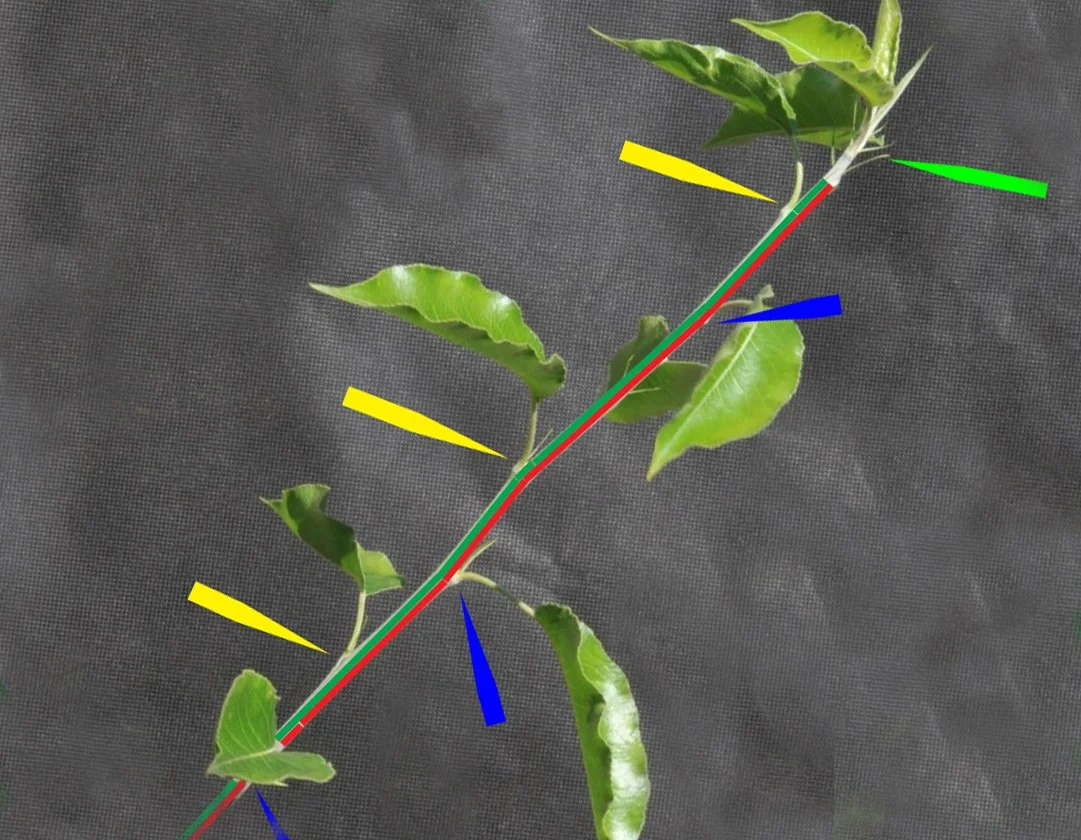
This shoot has been bent from vertical to 45 degrees. Less auxin flow down through the shoot from the apical bud (green arrow). Auxin already in the shoot flows more slowly down through the shoot and some accumulates on the lower side of the shoot (red in the shoot). Cytokinin flows up accumulating on the upward side of the shoot(green in shoot). The result is:
Extension growth of the shoot slows
The lateral buds on the upper side of the shoot (yellow arrows) promotes bud growth due to higher cytokinin concentration.
The growth of the lateral buds on the lower side of the shoot (blue arrows) is inhibited due to high auxin concentration.
Bending Branches and Shoots
The growth (branch extension) of fruit trees can be decreased or increased by various types branch bending to control apical dominance.
Arching


Branch Bending
Bend your branches for more fruit! Branches growing more horizontally will produce larger future harvests. If the branches on your tree are very upright, more than 60° from horizontal, they can be bent down to a more productive angle. Branches are most flexible during warm weather and when they are growing quickly as they are now. Younger branches are much more flexible than older branches, bend them when they one or two years old. Older branches do not bend easily, you may break some. A broken branch is better than an upright branch! When bending branches avoid stressing the junctions of branches with larger branches or the tree trunk. Right angle junctions are much stronger than sharp angled junctions. Caution: The wood of European plums and many pears is brittle when compared to apples, bend them with caution!
The closer to horizontal a branch is bent more extension growth will be suppressed so if you want that particular branch to grow to a greater length, keep it growing at a more upward angle until it is the desired length. Bending a branch below horizontal will stop all extension growth and is likely to stimulate new vertical shoots from the highest point on the shoot.
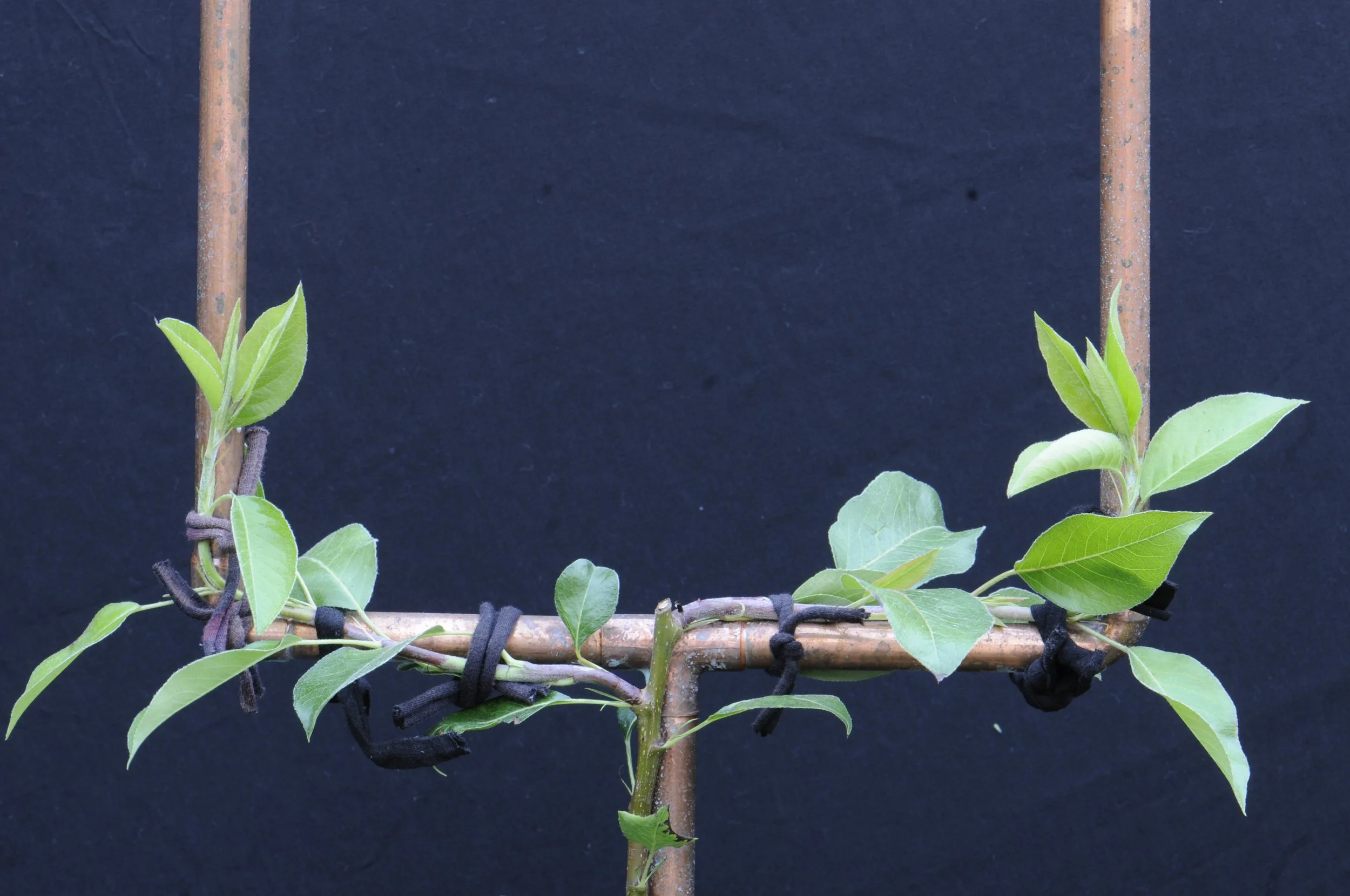
Hold bent branches in place with some type of tie or spreader. Tie material should be wide to prevent cutting into the bark of the branch. Bent branches held in place for 4 – 8 weeks of the growing season usually stay close to the bent angle once the released.
Tying material can be secured to lower branches, tree trunk a post or log on the ground or using some type of soil anchor. Spreaders are usually 1” X 1” sticks with a “V” cut in either length. Any rigid material including branches removed during pruning, plastic or metal can be used. Anything that will achieve the desired branch angel without damaging tree bark.
Spring is branch bending time! Fruit production potential of most fruit tree branches (apples, pears, quince, cherries, plums, apricots, peach, nectarine) is much greater if they are growing at an angle (at or below 30 degrees from vertical) than if they are growing vertically. During pruning, keep angled branches and remove vertical branches for larger future crops of fruit. If it is not possible to select for angled branches when pruning, you can increase future crops by bending upright branches. The goal is to bend without breaking them or splitting the crotch where they are attached to the rest of the tree. Small and big branches will all benefit from bending. Even branches that are already growing at an upright angle will produce more fruit in the future if they are bent to a lower angle close to 60 degrees from vertical.
Branches bend more easily when it is warm and the trees are growing, as they are now. You can also use spreaders to hold the branch in place. Branches can be tied to a trellis if there is one, to lower branches, the tree trunk or a board or weight on the ground. A bent branch tied in place should stay in that shape (or almost) if the tie is removed after 8 weeks during the growing season. For more information see this article.
Tree fruit producers have noticed a similar phenomenon where the tips of growing branches tend to bend upward, even when the branch was physically oriented to the horizontal. This condition, known as gravimorphism, is also caused by an auxin gradient within the branch in response to gravity. Auxin flows by gravity to the lower side of a limb. The subsequent accumulation of auxin is responsible for increased cell elongation on the underside of the limb, and the growing tip bends upward.
Another consequence of gravimorphism is the development of watersprouts from the upper surface of horizontally oriented limbs. Watersprouts are vertically growing shoots that develop from the upper surfaces of branches or near pruning cuts.
7
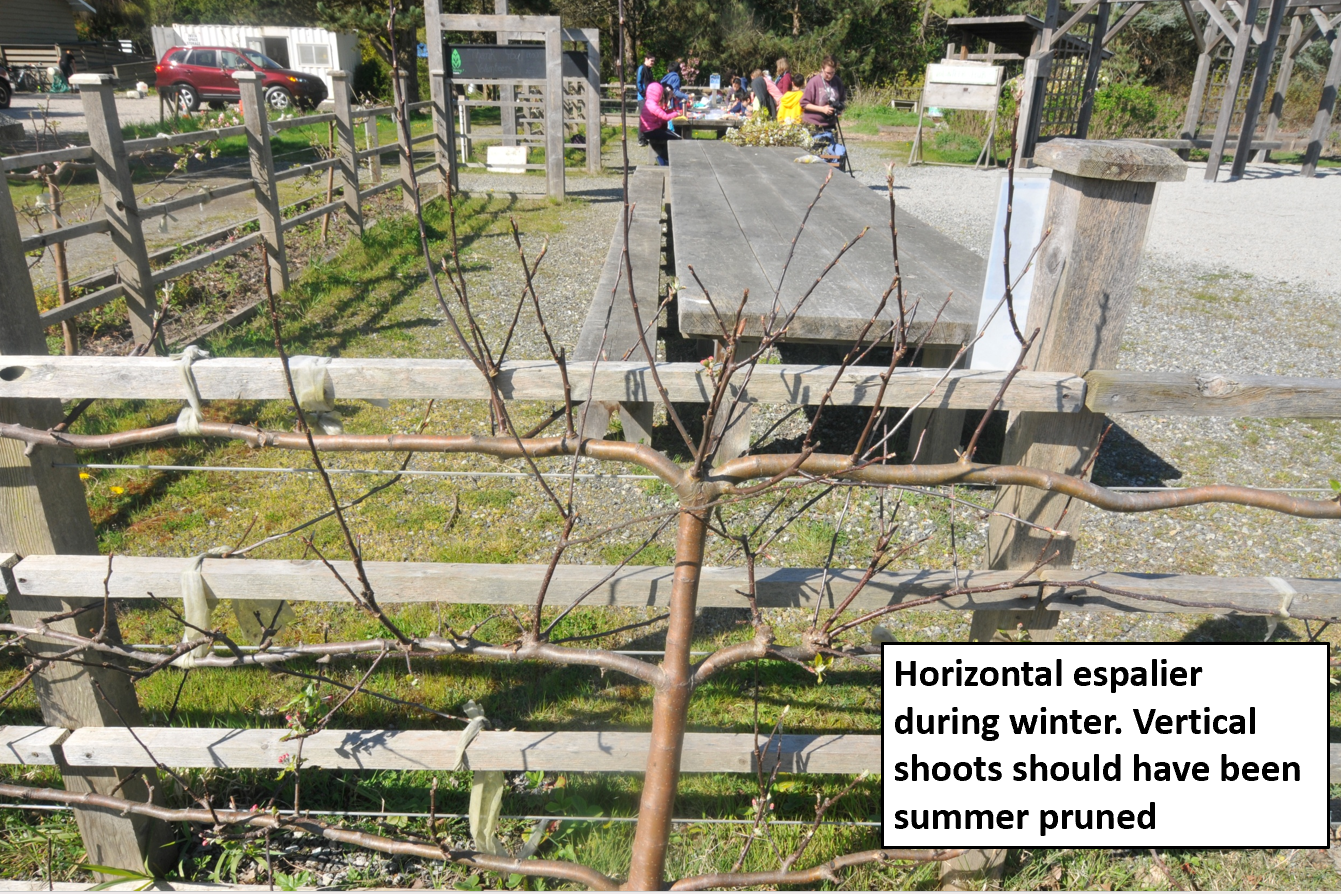
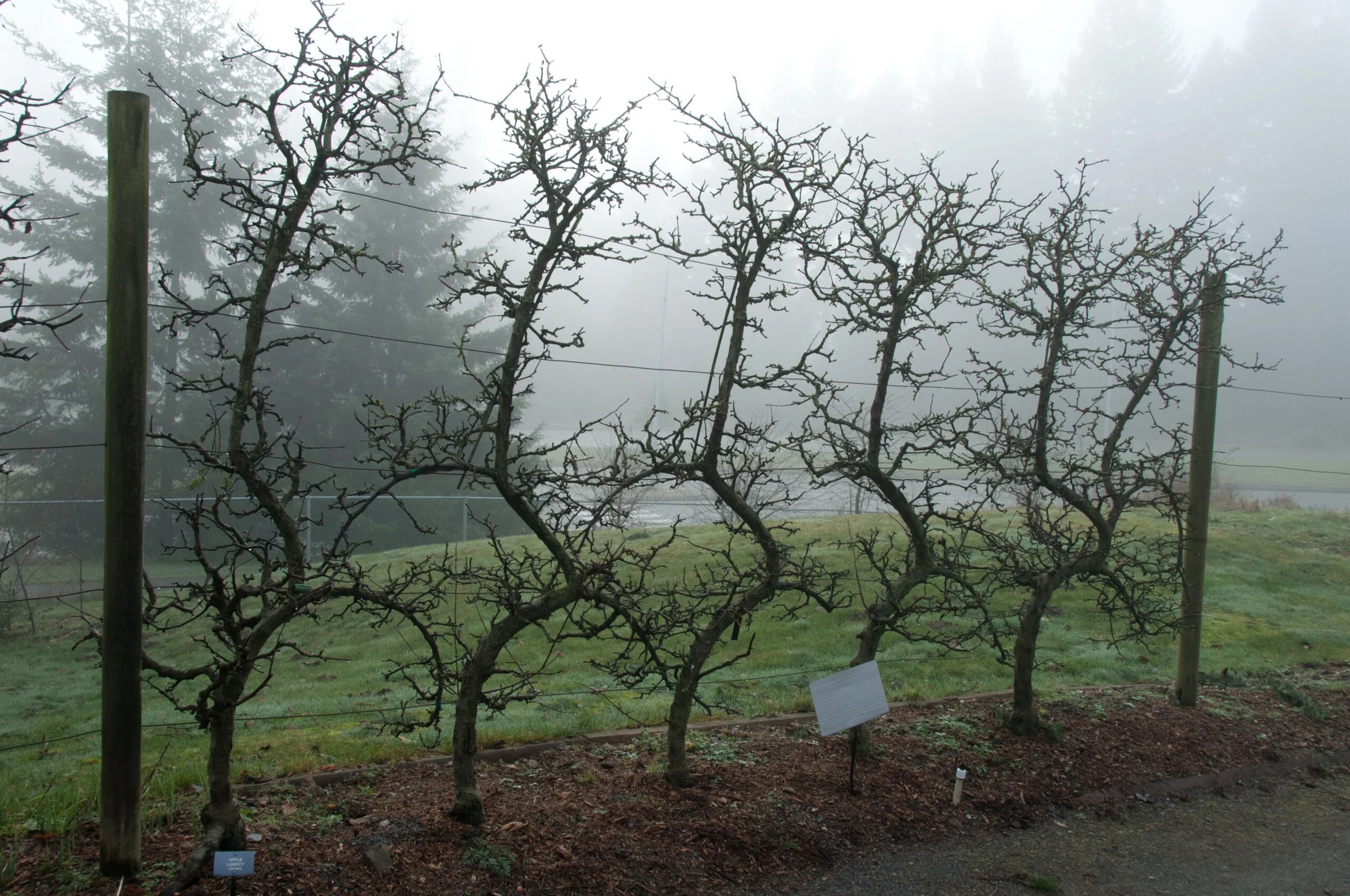
High auxin concentrations on the underside of the limb inhibits growth of buds on the underside of the limb, but the concentration of auxin on the upper side of the limb is inadequate to inhibit bud growth and many of these buds develop into watersprouts. Watersprouts are usually undesirable and their development can be suppressed by orienting limbs no more than 45 degrees from the vertical. Fruit trees are sometimes trained as espalier (tree fence). There are several ways to espalier trees, but one method involves orienting limbs to a horizontal position. This system induces many watersprouts along the length of the branches. Watersprout development can be greatly suppressed by orienting limbs 45 to 60 degrees above horizontal (Figure 9).
Reducing tree height by cutting into large diameter branches or trunks often results in the development of vigorous watersprouts around the cut. There are buds buried in the bark that normally remain dormant. However, a severe pruning cut will release these buds from dormancy.
Figure 9. Auxin distribution within a stem is controlled by gravity. When limbs are oriented from vertical to about 60 degrees from vertical, auxin is distributed fairly evenly around the limb and buds develop into shoots fairly symmetrically around the limb (A and B). Auxin accumulates on the underside of flat limbs (C and D) and inhibits growth of buds on the underside. Auxin concentration is low on the upper side and buds are not inhibited and develop into strong watersprouts.
When a vertical shoot is bent horizontal these things happens:
The apical bud producing of auxin slows or stops
Auxin already in the shoot moves to the bottom of the horizontal shoot
Lateral buds along the bottom of the shoot are suppressed by the auxin
Lateral buds along the top of the shoot, no longer under apical control, develop into new upright shoots
As shoots or branches are bent away from a vertical position the number and length of lateral shoots are increased while extension growth is decreased.
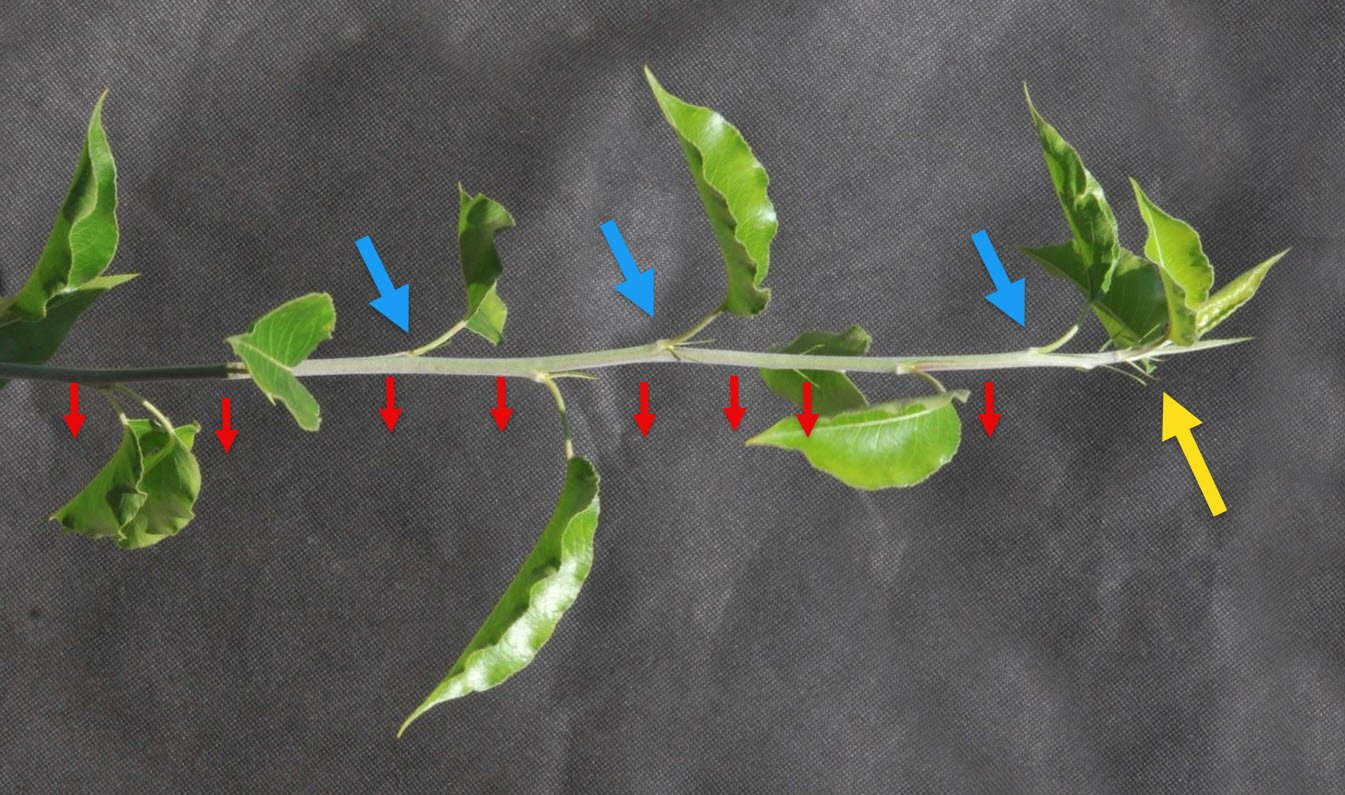
Green on shoot is high cytokinin level, red is high auxin level. Yellow arrows indicate buds that are now released to grow into shoots, the blue arrows indicate buds that will not grow. The green arrow points to the terminal bud that slows of stops growing once the shoot is horizontal.
bending branches
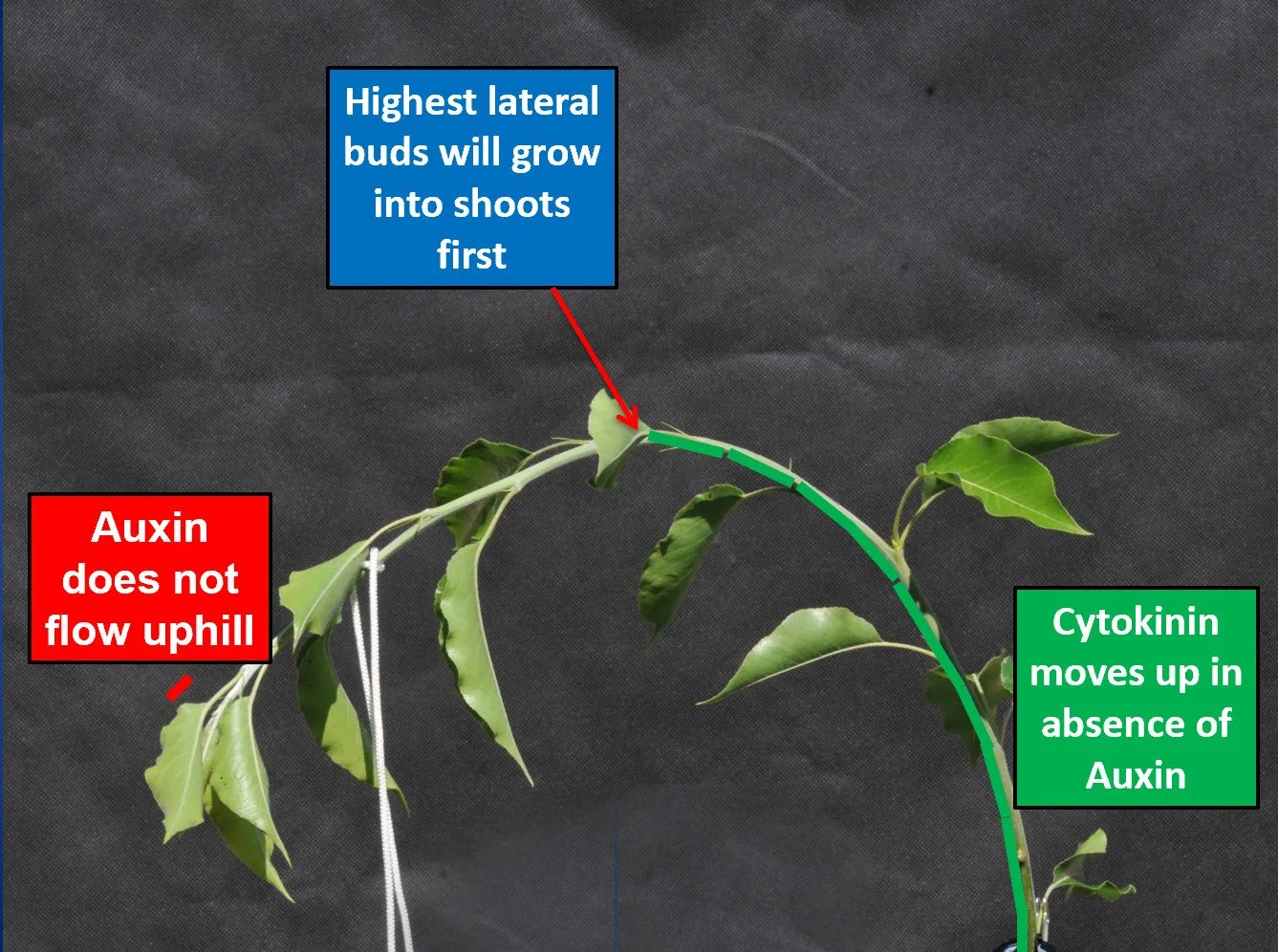
When you bend a branch or shoot below the horizontal position—so that the tip is at the lowest point—the dominant bud at the highest point on the bend will develop into a strong vertical new shoot, especially when the trees are young.
Bend a shoot to below horizontal from the joint with trunk - diagram of this for pear with longest new vertical laterals are close to trunk
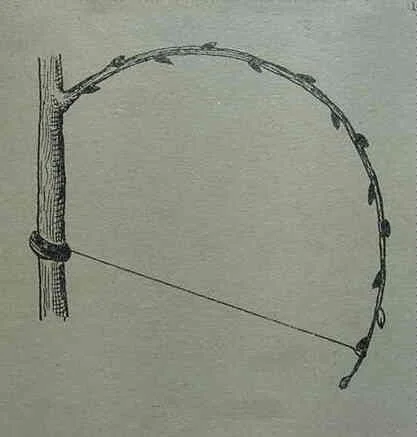
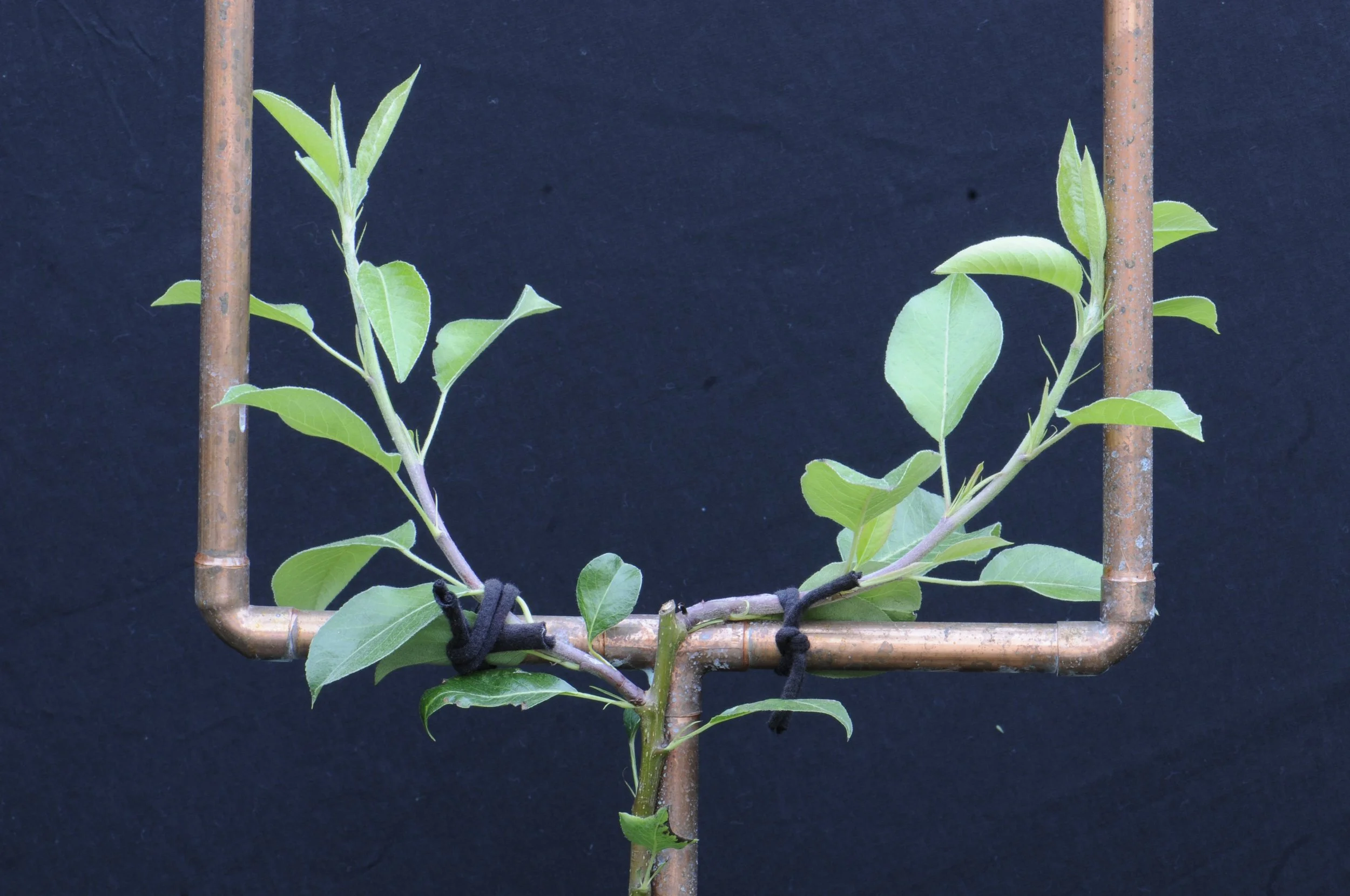
Bending a shoot in an arc
Bending and arching affect apical dominance differently
Auxin produced in the terminal bud does not suppress growth of other buds. Auxin can only move downward, not upward. The absence of auxin, the presence of cytokinin plus the sink effect result the buds starting to grow. Soon the new shoots are producing auxin suppressing buds below them.
If shoots or branches are arched below the horizontal, apical dominance by the bud at the tip is lost.
Auxin accumulates in the lower side of the shoot or branch, and cytokinin accumulates in the uppermost buds on the curve of the shoot or branch.
These buds, which are no longer under any apical control, develop into new upright shoots as the tree seeks to reestablish apical control in the shoot or branch.
Inside a branch that has just been bent away from vertical, auxin present in the shoot redistributes to the shaded and/or lower side of the stem. This causes the cells on the shaded and/or lower side to elongate more rapidly than those on the upper or/sunny side, resulting in the bending upward or towards the light source.
The movement of auxin to the lower or shaded side also inhibits the growth of lateral buds on that side and promotes growth of lateral buds on the upper and/or sunny side.
Bending one year old or current season vertical shoot
Bending shoot over 45 degrees keeping shoot straight
Bending shoot over to 30 degrees keeping shoot straight
Bending shoot to horizontal keeping shoot straight if possible
Bending shoot to in an arc
Bending shoot to horizontal keeping shoot straight if possible and then bend the end of the shoot up to 45 degrees
when shoot bent apical bud produces less auxin and it looses vigor sharing the energy availalber with lateral buds
No AD in dormancy
AD strongest in vertical shoots and apples and pears
Auxin moves with gravity
Branch attachment angle
When pruning in summer, shaded areas are obvious and easy to reduce
Technique #4 Shoot Bending
As shoots or branches are bent away from a vertical position the number and length of lateral shoots are increased while extension growth is decreased. need image of this
need to add this is what happens if a branch can be bent at a po0int close to the trunk and stay as a straight shoot
Need a desription of ways to bend a shoot and the choice ofa good shoot to bend. Also what can happen if try to bend a very up right shoot or one with included bark. could use the bonsai tool or soften the branch inside the bark by wiggling around.
If you bend a vertical shoot to 45 degrees or select for branches growing at this angle when pruning, apical dominance will be weaker. If you bend a shoot to horizontal, dominance is temporarily eliminated.
A branch growing or bent to a 45 degree angle will exhibit partial apical dominance, with just a few lateral buds becoming shoots. Therefore, apical dominance can be controlled by either pruning off the terminal bud, or by adjusting the angle of the branch.
When a vertical shoot is bent horizontal these things happens:
The apical bud producing of auxin slows or stops
Auxin already in the shoot moves to the bottom of the horizontal shoot
Lateral buds along the bottom of the shoot are suppressed by the auxin
Lateral buds along the top of the shoot, no longer under apical control, develop into new upright shoots
As shoots or branches are bent away from a vertical position the number and length of lateral shoots are increased while extension growth is decreased.
Green on shoot is high cytokinin level, red is high auxin level. Yellow arrows indicate buds that are now released to grow into shoots, the blue arrows indicate buds that will not grow. The green arrow points to the terminal bud that slows of stops growing once the shoot is horizontal.
If a shoot is bent and tied down to the horizontal, auxin moves downward, to the lower side of the stem and inhibits buds there; however the top side of the stem is released from the auxin inhibition, allowing bud growth all along the stem, producing vertical water sprouts.
Bending Tools and Materials
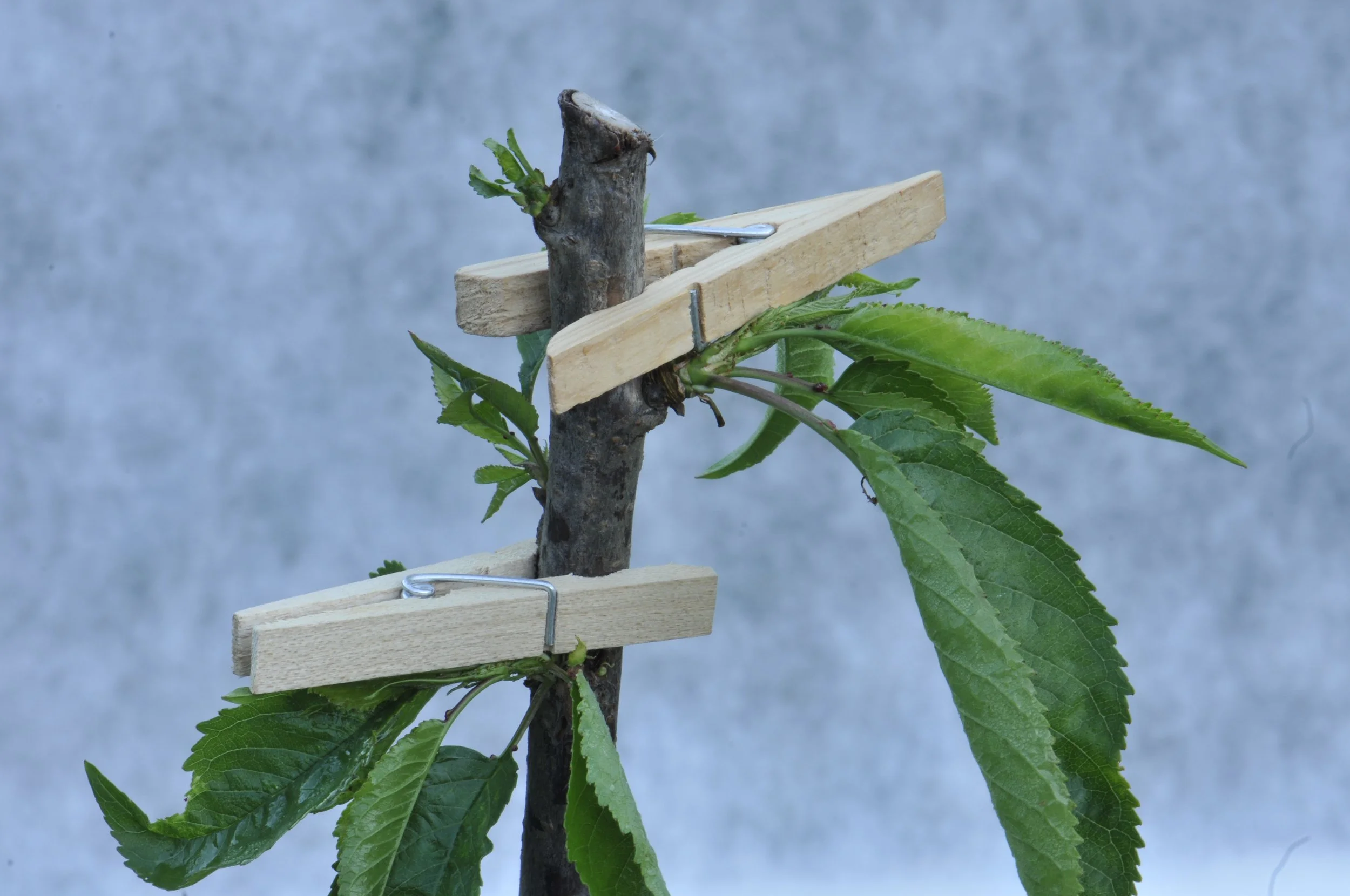
Clothes pins
bonsai wire
bending devices from amazon
Bonsai bender
The trellis is a permanent a an anchor lateral shoots can be tied to and to ensure the tree form does not drift form the original design???????????
Bending with bonsai wire
Bending with clothes pins
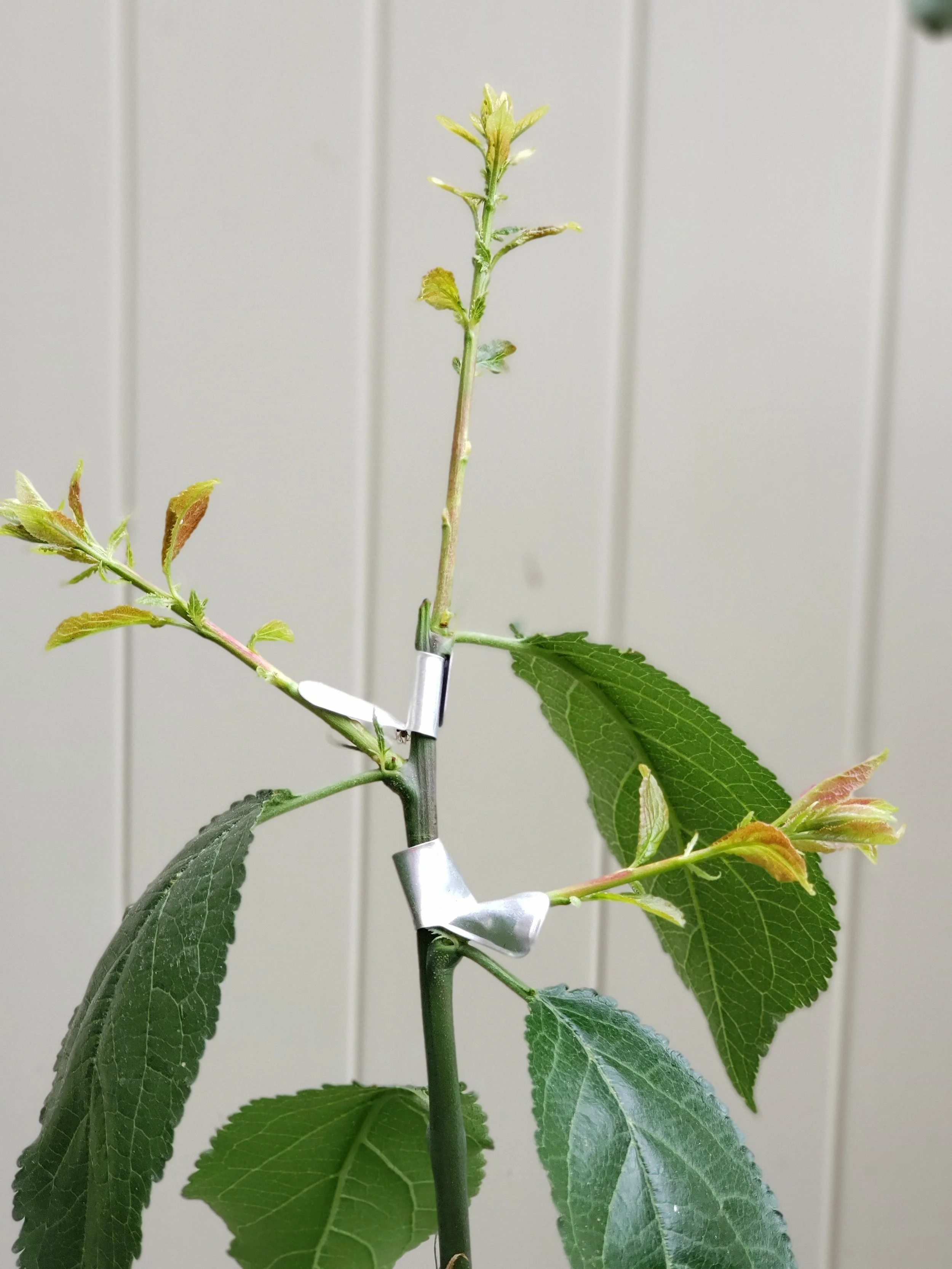
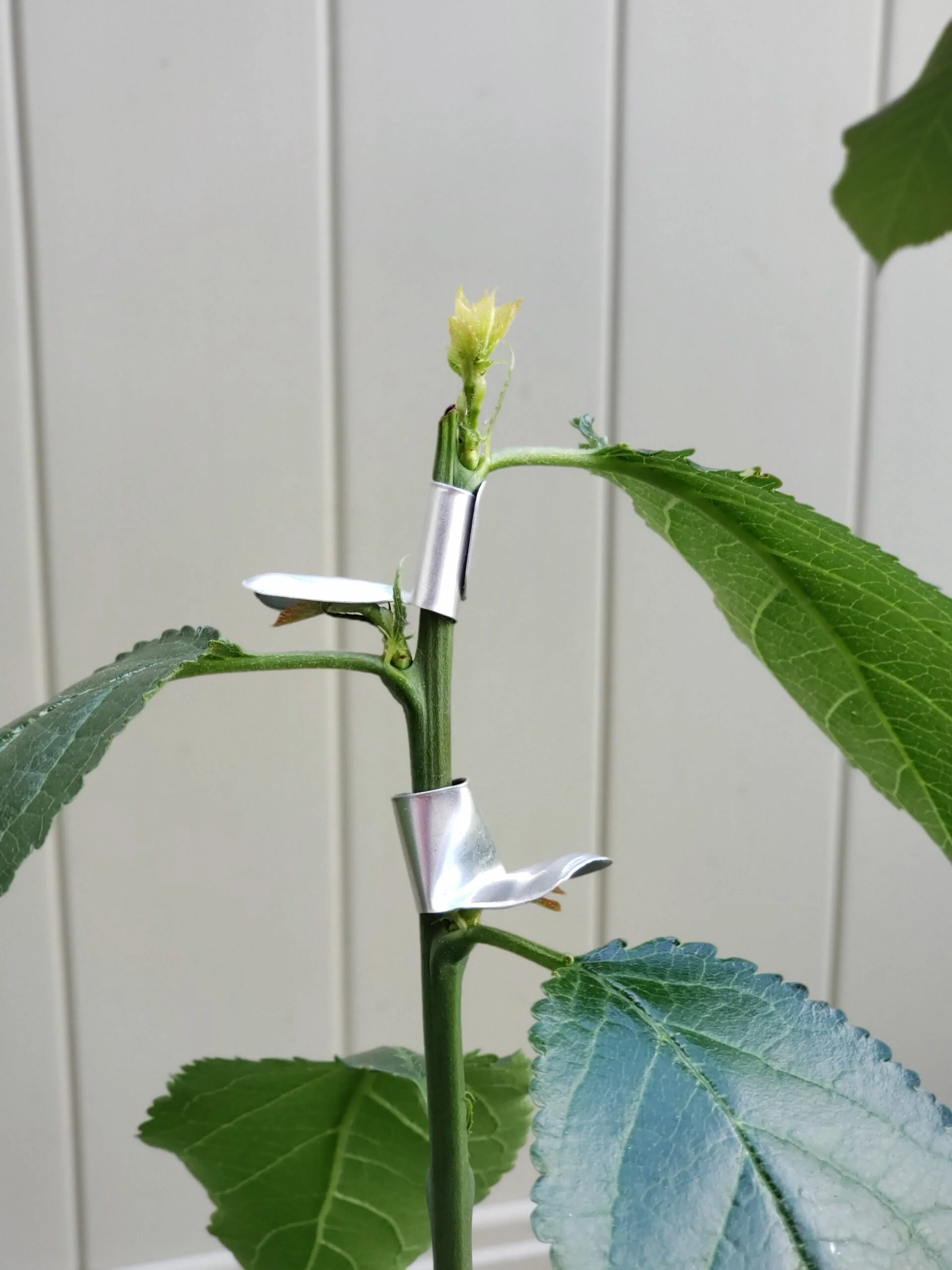
Bending with bud clips
If a shoot is bent and held in place during the growing season, after 6 to 8 weeks, is should stay bent.
need to edit image below to move auxin box away from shoot, arrows for cytokinin movement. As above yellow arrows to buds that will grow and produce auxin, blue arrows to buds that will not grow. Need to state that the top buds growing is similar to any shoot starting in the spring, sink effect pushes the highest.
Hormones in bent shoot
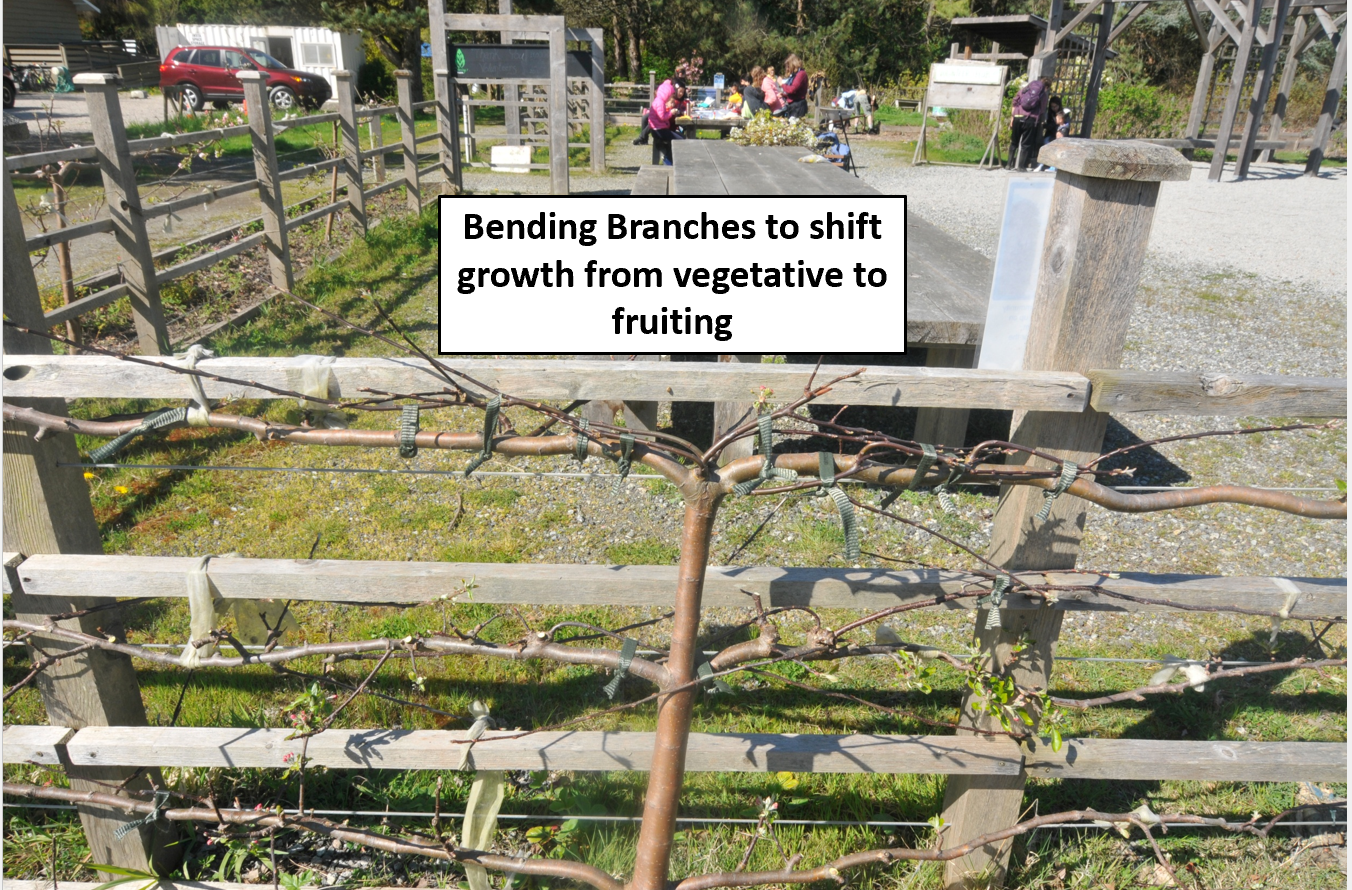
Branch bending is commonly used when training fruiting apple and pear trees to produce the short, weak branches that develop into fruit spurs.
Bending
just the tip of vertical one year old growth
Bending vertical branch from near the base to 45 degrees
Bending vertical branch to horizontal
Bending vertical shoot to 45 degrees and in an arc with the apical bud pointing down
Bend a lateral shoot close to trunk to a below horizontal position
When the apical bud is removed, the source of IAA is removed. Since the auxin concentration is much lower, the lateral buds can now grow.
The above diagram demonstrates the range of responses that usually result from a no cut, 1/4 removal, 1/2 removal and 3/4 removal. The more aggressive the cut the stronger the response. All these cuts are into a one year old shoot that starts out with no lateral branches. Note that the response to removal of 1/2 or 3/4 results in the formation of a group of branches with in 3" - 6" of the cut.
From Bending
Bend your branches for more fruit! Branches growing more horizontally will produce larger future harvests. If the branches on your tree are very upright, more than 60° from horizontal, they can be bent down to a more productive angle. Branches are most flexible during warm weather and when they are growing quickly as they are now. Younger branches are much more flexible than older branches, bend them when they one or two years old. Older branches do not bend easily, you may break some. A broken branch is better than an upright branch! When bending branches avoid stressing the junctions of branches with larger branches or the tree trunk. Right angle junctions are much stronger than sharp angled junctions. Caution: The wood of European plums and many pears is brittle when compared to apples, bend them with caution!
The closer to horizontal a branch is bent more extension growth will be suppressed so if you want that particular branch to grow to a greater length, keep it growing at a more upward angle until it is the desired length. Bending a branch below horizontal will stop all extension growth and is likely to stimulate new vertical shoots from the highest point on the shoot.
Hold bent branches in place with some type of tie or spreader. Tie material should be wide to prevent cutting into the bark of the branch. Bent branches held in place for 4 – 8 weeks of the growing season usually stay close to the bent angle once the released.
Tying material can be secured to lower branches, tree trunk a post or log on the ground or using some type of soil anchor. Spreaders are usually 1” X 1” sticks with a “V” cut in either length. Any rigid material including branches removed during pruning, plastic or metal can be used. Anything that will achieve the desired branch angel without damaging tree bark.
Spring is branch bending time! Fruit production potential of most fruit tree branches (apples, pears, quince, cherries, plums, apricots, peach, nectarine) is much greater if they are growing at an angle (at or below 30 degrees from vertical) than if they are growing vertically. During pruning, keep angled branches and remove vertical branches for larger future crops of fruit. If it is not possible to select for angled branches when pruning, you can increase future crops by bending upright branches. The goal is to bend without breaking them or splitting the crotch where they are attached to the rest of the tree. Small and big branches will all benefit from bending. Even branches that are already growing at an upright angle will produce more fruit in the future if they are bent to a lower angle close to 60 degrees from vertical.
Branches bend more easily when it is warm and the trees are growing, as they are now. You can also use spreaders to hold the branch in place. Branches can be tied to a trellis if there is one, to lower branches, the tree trunk or a board or weight on the ground. A bent branch tied in place should stay in that shape (or almost) if the tie is removed after 8 weeks during the growing season. For more information see this article.
Also from Bending
Tree fruit producers have noticed a similar phenomenon where the tips of growing branches tend to bend upward, even when the branch was physically oriented to the horizontal. This condition, known as gravimorphism, is also caused by an auxin gradient within the branch in response to gravity. Auxin flows by gravity to the lower side of a limb. The subsequent accumulation of auxin is responsible for increased cell elongation on the underside of the limb, and the growing tip bends upward.
Another consequence of gravimorphism is the development of watersprouts from the upper surface of horizontally oriented limbs. Watersprouts are vertically growing shoots that develop from the upper surfaces of branches or near pruning cuts.
7
High auxin concentrations on the underside of the limb inhibits growth of buds on the underside of the limb, but the concentration of auxin on the upper side of the limb is inadequate to inhibit bud growth and many of these buds develop into watersprouts. Watersprouts are usually undesirable and their development can be suppressed by orienting limbs no more than 45 degrees from the vertical. Fruit trees are sometimes trained as espalier (tree fence). There are several ways to espalier trees, but one method involves orienting limbs to a horizontal position. This system induces many watersprouts along the length of the branches. Watersprout development can be greatly suppressed by orienting limbs 45 to 60 degrees above horizontal (Figure 9).
Reducing tree height by cutting into large diameter branches or trunks often results in the development of vigorous watersprouts around the cut. There are buds buried in the bark that normally remain dormant. However, a severe pruning cut will release these buds from dormancy.
Figure 9. Auxin distribution within a stem is controlled by gravity. When limbs are oriented from vertical to about 60 degrees from vertical, auxin is distributed fairly evenly around the limb and buds develop into shoots fairly symmetrically around the limb (A and B). Auxin accumulates on the underside of flat limbs (C and D) and inhibits growth of buds on the underside. Auxin concentration is low on the upper side and buds are not inhibited and develop into strong watersprouts.
undercutting large branch to bend
Technique# W - When want to bend a lateral shoot off leader bend to 45 degrees in early spring to allow shoot to continue extension growth. in the fall or following spring bend to horizontal. If shoot need to extend further use Technique Z
Technique# x - S bend or Snaking
This technique was used in slender spindle training of apples. - my image
Technique# y - Bend followed with delayed bend
Bend to horizontal till vertical shoots from the upper side of the shoot are 1" - 2" then bend it 180 degrees in the other direction to shift auxin and cytokinin concentrations and grow vertical shoots out of the new upper side of the shoot
This is about bending a shoot to one side till top buds start to grow and then bend 180 degrees so top buds start growing on the other side. This could be used new whip trees or and shoot on the tree that you want lots of lateral branches on
Technique# z - Bending a branch flat for horizontal branch but bent the tip of the branch up to continue extension growth